Expand Cut Tags

No cut tags
ahunter3: (Default)
Once upon a time there was a culture, and as you might expect, the people in that culture held beliefs about how life was for them.

The predominant notion, the one held by the mainstream of people, was that relationships were sort of like parallel lines, moving in the same direction, although that direction might change from time to time; there would be some zigs and some zags, but the lines never touched, and were not supposed to.

Something like this, if you were to draw it like a diagram:
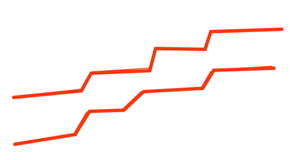
zig zag parallel lines

This is fundamental to our culture, they said; this is the floor upon which everything else resides, so this is important!


Well, there were people who interacted differently, and experienced matters differently, and they were considered by the mainstream to be doing something they were not supposed to. These folks spoke with each other about their own experience and discarded the predominant notion, and formulated their own beliefs about how life actually was.

Relationships were actually like cells, and all cells touched adjoining cells and there was nothing akin to the untouching parallel paths that the mainstream folks liked to describe.

They began drawing this symbol and wearing it on their t shirts and putting it on flags that they carried at their rallies:
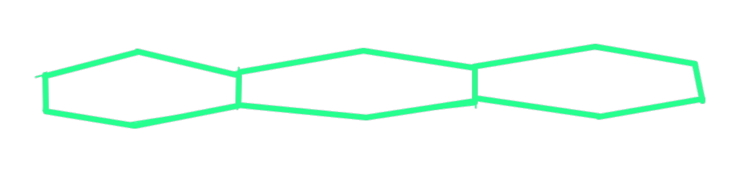
touching cells

"What's WRONG with the mainsteam people?", some of them asked each other. "Why do they insist that reality is something it so obviously is not? We have shown them, we have pointed, and still they deny the absolute truth of the touching cells -- why?"

"Oh, they do it specifically because they hate us", came the answer. "It's a lie, since the truth is plain to see. The purpose of the lie is to have an excuse to condemn us!"

And in mutual support and solidarity, they embraced the understanding they had as the foundation of liberty and equality and all possibility of peace, so that lies like this could not bring them down again.


Then one day some other people who also interacted with a different pattern than the one prescribed by the predominant culture spoke up and said "Actually we do have the lines. We also have cells but for us the cells don't touch each other. They're separated by lines. We think you've got it a bit wrong. It's really more like this:
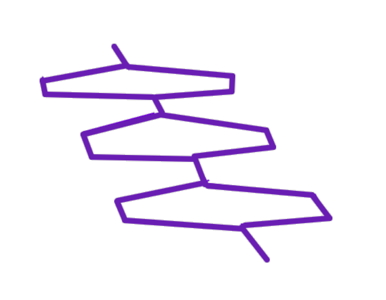
separated cells

And the touching-cell activists frowned in disapproval of these new dissidents. "We support you for being hated on and attacked by the dominant culture group, but you really need to listen. You are falling into their trap by believing in separation. Your model would leave cells so that they don't adjoin each other and that is the real essence of what is bad about the mainsteam insistence on parallel lines that never touch. So you need to get over that, okay?"

Meanwhile, the mainsteam folks were quick to condemn the new dissidents the same way they had done for the touching-cell folks, because they were all threats to the essential doctrine of separate parallel lines. It was okay to zig and zag but not to touch!

Pretty quickly the new dissidents got mad and began saying that the touching-cell folks were lying and were full of hate, because the baseline truth was right there in plain sight if one cared to look, and this intolerance could not be excused just because the touching-cell movement people considered themselves outcasts and therefore social victims of the mainsteam.


This is, of course, a metaphor, and you probably already anticipate the visual punch line:
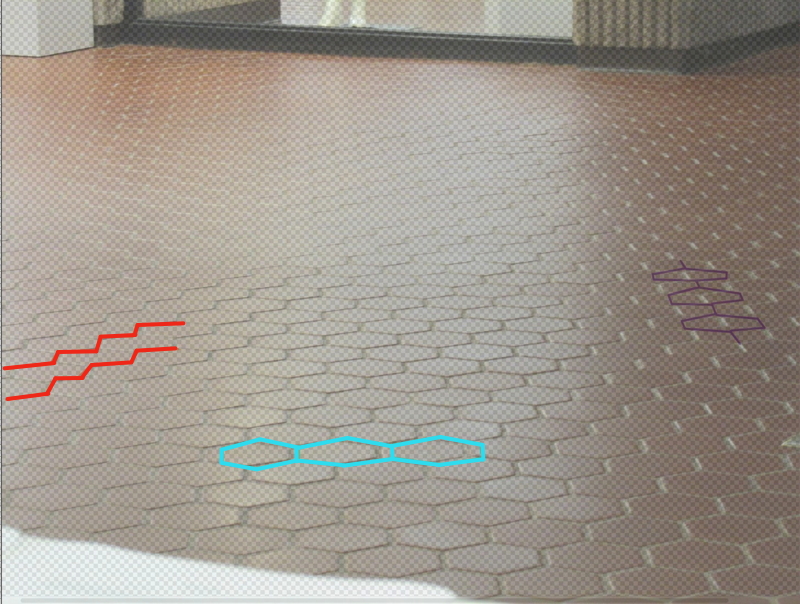
floor problem


Before you say "Yeah yeah, blind men and elephants, etcetera, and 'why can't we all just get along' thrown in at the end, seen it and heard it before", the point is actually not so much "Gee why can't we just get along", nor is it "let everyone have their own reality and don't condemn anybody else", really. The point I'd like you to take back from this is that things look differently based on how the light falls on them and the angle from which one views things, but if, instead of contradicting what someone else is seeing, you get them to start there and move their eyes far enough to see how the other interpretation can be perceived as part of the same overall pattern -- then you have a chance of communicating.


And yeah, I had specific groups in mind. Of course I did. The mainstream view is the cisgender heterosexual patriarchal floor plan. The touching-cell folks are the second wave radical feminists. The new dissidents are the gender identity activists, including trans and genderqueer and nonbinary people.

I don't care who you are, quit holding on to the notion that in order for you to be right, they have to be wrong. Quit using their hate and intolerance as a reason for ignoring their perspective. Of course hate and intolerance is wrong, and of course their insistence that your truth is wrong is, itself, wrong. But be leery of the possibility that their hatefulness and their refusal to listen to you is being mirrored in your own behaviors.

—————


My first book, GenderQueer: A Story From a Different Closet, is published by Sunstone Press. It is available on Amazon and Barnes & Noble in paperback, hardback, and ebook, and as ebook only from Apple, Kobo, and directly from Sunstone Press themselves.


My second book, That Guy in Our Women's Studies Class, has also now been published by Sunstone Press. It's a sequel to GenderQueer. It is available on Amazon and on Barnes & Noble in paperback. eBook version and hardback versions to follow, stay tuned for details.


Links to published reviews and comments are listed on my Home Page, for GenderQueer now and for Guy in Women's Studies once they come out.

———————

This DreamWidth blog is echoed on LiveJournal and WordPress. Please friend/link me from any of those environments on which you have an account.

————————


Index of all Blog Posts
ahunter3: (Default)
Here's a snippet from That Guy in Our Women's Studies Class --


Queenie’s perspective seemed to be mostly formed around belonging to an already-existing category that people knew about, while mine on the other hand was all wrapped up in theory, describing myself as belonging to a hypothetical group that I then had to describe.

If I was understanding correctly, all the gay males that Queenie had grown up knowing about painted their nails, wore dresses and skirts and high heels, did their hair, carried handbags and purses, and referred to each other with female pronouns. Or at least except for the ones trying to keep it hidden. That was how you did gay. It wasn’t a thing separate from doing femme.


My first book, GenderQueer, was a story of gradually arriving at a gender identity that wasn't already out there available for me to join, because "genderqueer" wasn't a term or a concept in our society yet.

Guy in Women's Studies on the other hand, mostly is a description of my primary attempt to join, to link up to a community, a culture, a movement. To be a part of. To participate.

Not only was it an era before "genderqueer" was trending, it was also an era before the rise of academic departments and majors called "gender studies" or "women's and gender studies" or "women, gender, and sexuality studies". Instead, what existed were departments of women's studies. That was the main place that gender and biased gender expectations were being discussed, or at least the main place where I, a male, could enroll and attend.

So that's where I went.


I think both modalities have their limitations as well as their strengths. When you seek to join an existing identity, you are to some extent fitting yourself into a pre-existing box. So in the case of gender, here we have people rejecting the notion that they should fit themselves into the gender box that is designated for a person of their physical morphology... but who then look around for a different existing box to move themselves into. I'm serious: I'm in a dozen or more Facebook groups devoted to being gender-variant in assorted ways, and in all of those groups there is a constant trickle of young people coming in to post, "I came out as nonbinary and ace aro when I was 16 but lately I've been wondering if I'm actually demiboy and grey ace or even demisexual? The thing is, I don't know if I can really say I'm a demiboy though since sometimes I like to wear skirts in the summer, and I don't want to be a fake, what do you think?"

So yes, people really are measuring themselves against these identities and then worrying in a way that's at least a little bit like the original friction of measuring one's self against the original imposed binary gender identity that society tried to impose. I mean, yeah, on the one hand, there isn't enormous social pressure to pick that particular box, the way there is with the original pink-and-blue box pair. But on the other hand, these aren't young people who are saying "Well, a good portion of the descriptions of 'demiboy' and 'grey asexual' apply to me, but there are also ways in which I don't fit the assumptions, so whatever, something like that". They're fretting about it. Needing to find an identity, an existing label that fits them like tailored clothing.

To formulate one's own identity definition, of course, rescues one from that sense of perhaps picking the wrong box. But the limits on this side of the divide are all about going it alone, not having any kind of social pre-existing understanding of the kind of person you're claiming to be and having, instead, to explain it all to people. Many of whom may not find it all that interesting to listen to such a complex and detailed self-description. And while the people trying to pick the correct existing box often seem to walk around with an internal doubt, a sort of impostor's syndrome, those of us who have gone around inventing our own labels and identities and spent time trying to live our lives espressing and explaining ourselves in those terms get a lot of external doubt, the dismissive and sometimes hostile attitude of other people that we're fakes, that our identities can't be real because if they were real, why hadn't they heard of such identities before?


—————


My first book, GenderQueer: A Story From a Different Closet, is published by Sunstone Press. It is available on Amazon and Barnes & Noble in paperback, hardback, and ebook, and as ebook only from Apple, Kobo, and directly from Sunstone Press themselves.


My second book, That Guy in Our Women's Studies Class, has also now been published by Sunstone Press. It's a sequel to GenderQueer. It is available on Amazon and on Barnes & Noble in paperback. eBook version and hardback versions to follow, stay tuned for details.


Links to published reviews and comments are listed on my Home Page, for GenderQueer now and for Guy in Women's Studies once they come out.

———————

This DreamWidth blog is echoed on LiveJournal and WordPress. Please friend/link me from any of those environments on which you have an account.

————————


Index of all Blog Posts
ahunter3: (Default)
"It's surprising to me that you aren't sure the trans community will accept gender queer people who don't transition", my friend writes in response to something I had posted. "Many such people do identify as trans and are active in the community, particularly in specifically non-binary spaces".


Yeah, let me explain and unpack that a bit.

Early this week, in another, very different space, someone else had posted something dismissive about trans people -- there was a photo of a bathroom door with all kinds of alternatives to the conventional male and female bathroom silhouettes along with the notice "We don't care, just don't pee on the seat" or something to that effect; the person posting it had then written a screed about how fragile and self-immersed and pathetic these kids these days are, etc.

So I wrote some descriptions of the shit I'd had to put up with from my classmates, the sissyphobia and homophobia and misogyny bundle, you know? What it had been like being harassed for being sissy and femme. And how since they had made an issue of it and acted like it was my secret shame, I damn well had the right to make an issue of it myself to say I was proud of my identity.

I got some likes and some supportive comments but I also got people saying that this shouldn't make it necessary to transition because I'm just as entitled to walk around in the body I was born in as those bullies were. So I explained that I am not a transitioner, that I don't present as female, that I identify as femme but also as physically male.

"Oh", they said. "Well, that makes more sense. But these pathetic people we're talking about, they don't do that. They have to change their name and their pronouns and put on a dress and tell us we have to accept their identity".

So these transphobes are seizing on nonbinary people like me who don't transition and using us as a weapon to attack our trans sisters and brothers.

That happens. It isn't rare. It's a thing.

Now, let's consider the kind of things I myself say. I'm not merely a genderqueer person who does not transition. I'm a loud and pushy genderqueer person who is tired of feeling erased so I make a lot of noise about having an identity that is different from the type of trans identities that comprise the main cultural narrative about being trans. I'm constantly mouthing off about not being a transitioner. I'm often challenging language used and generalizations made in transgender / genderqueer groups when it doesn't leave room for people who consider themselves women or femme but don't present as female.

My behavior reminds a lot of trans people of those transphobes. Because identities like mine have been weaponized against them. Used to attack the legitimacy of their identities.

We should not let them divide us that way. Those nasty creepazoids don't legitimately accept my identity. They use the word "just". As in "See, you can just be nonmasculine and still be male". They trivialize my experience and my identity. They will go on to say I don't have a separate gender identity, I'm just a man who likes to eat quiche and watch chick flicks or something. They plug their ears about how polarizing it is to be perceived as male but to be (and to be perceived as being) a person with the priorities and tastes, behaviors and attitudes that are expected of girls and women and not the ones associated with boys and men. They pretend they are fine with that as long as I don't transition and ask them to accept me as female. They pretend they aren't participating in the problem, that it wasn't them calling me names and exhibiting attitude and dropping insinuendos about what's wrong with me.

My trans sisters and brothers who transition are my kin. What works for me does not work for them. They have the right to be, to exist socially without being misgendered or condescended to. Nobody has any justification for questioning the route they have taken, which validates their identity and lets them stand proud. They need a supportive medical community and insurance coverage, they need to be allowed to pee without people questioning or challenging their gender identity, they need to be able to walk down the sidewalk in peace and in safety. And they need to not have identities like mine thrown in their faces like gender was some kind of One Size Fits All boutique and cisgender bigots are suddenly the fashion aribrators.

You do not have my consent to use me as a goddam weapon.


———————

This DreamWidth blog is echoed on LiveJournal and WordPress. Please friend/link me from any of those environments on which you have an account.

————————


Index of all Blog Posts


———————


Do you counsel young people trying to sort out their gender identity? You should read my book! It's going to add a new entry to your map of possibilities when you interact with your clients!

My book, GenderQueer: A Story From a Different Closet, has been published by Sunstone Press. It is available on Amazon and Barnes & Noble in paperback and ebook, and as ebook only from Apple, Kobo, and directly from Sunstone Press themselves.


My second book, That Guy in Our Women's Studies Class, is also being published by Sunstone Press. It's a sequel to GenderQueer Stay tuned for further details.


Links to published reviews and comments are listed on my Home Page

———————

This DreamWidth blog is echoed on LiveJournal and WordPress. Please friend/link me from any of those environments on which you have an account.

————————


Index of all Blog Posts
ahunter3: (Default)
When I was born, I was categorized based on visual inspection of my parts, and designated male.

You've heard all this before, over and over. I don't need to repeat objections that you could recite as easily as I could. Let's do something more interesting... let's dive into the head of the people who don't understand what we're objecting to.

I'm picking this guy, let's call him Sammy. He says that as far as he's concerned, the designation and categorization mean exactly the same thing as the parts themselves. "Penis means you're male. I ain't saying that makes you Rambo. Maybe you're into ballet, or you want to be Earth Mom. I don't care if you paint your room pink or blue or you play with dolls or fire engines, you hear what I'm sayin'? Male just means you got a penis and we figure you're gonna grow hair and so on because that's what usually happens."

Sammy is effectively making the claim that he — and most of the rest of the world — doesn't attach any additional meaning to being male.

He is wrong. He does it all the time, I've seen him do it over and over. In a discussion of evolutionary pressures and social status, he said the high status males will naturally be the ones who have sex with the most females, while the highest status females will be the ones who only have sex with a few carefully selected males. That's attaching a significance to "male" that goes far beyond "has a penis". And in discussions of romantic comedy movies, he described a character played by Katharine Hepburn as having "won" against the male lead when he ends up proposing marriage to her — "she got him, he's captured". Sammy can protest all he wants about how he isn't projecting pink versus blue expectations and roles onto people and attaching those things to what sex he considers them to be, but he's definitely doing it, and the society that surrounds us is definitely doing it.

It's hard to know what to say to someone who insists that they are only seeing and thinking in terms of physical body structure when they clearly show that they assume different priorities, different values, different behavioral patterns, different personality characteristics... and different roles that interact with other, equally sex-specific roles.

Maybe it's a good thing to aspire to. Maybe we should all be trying not to assume anything whatsoever about how a person will behave or what's important to them in life based on whether we perceive their bodies to be male, or female instead. Maybe we should all be trying not to interpret the same behavior as meaning a different thing depending on whether we perceive the person to be female or to be male. But pretending that nobody does that any more except for transgender and genderqueer and nonbinary people, as if the rest of the world doesn't attach any meaning to being a man or being a woman other than the physical? Give me a break!

That's not to say that it isn't useful to think of, and speak of, the physical architecture separately from the identity, the gendered self that we have come to believe is not defined by our sexual plumbing. If being born with a clitoris and vagina does not make one a girl or a woman, then you don't need to have a clitoris and a vagina in order to be one, nor to present and pass as a person who has that kind of physical architecture. If your gender identity is valid, then it's valid on the nude beach or the doctor's examining room. It's valid when you're wearing the garments that are typically worn by the people who have the same physical body structure instead of the garments typically worn by the people who have the same gender identity.

Trans people often say "Trans women don't owe you femininity". Well, I don't owe you the need to be thought of as physically female.

There are other people — some of my trans brothers and sisters — whose situation is different from mine. Some of them do need to do a medical transition. And I support them and their rights and their need for social and medical accommodations.

But me, I don't need false breasts. I don't need real breasts. I don't need brassieres. I have no interest in lipstick or rouge, I don't own a single pair of high heels, and I don't paint my fingernails. My face grows hair because of my hormones, and I don't shave it off, nor do I pluck it. It grows there naturally. I don't owe you femaleness. I'm femme. You'll discover who I am soon enough if you interact with me.


———————

You're secluded in quarantine, and all the performances and events have been cancelled, so it's a good time to read a book!

My book, GenderQueer: A Story From a Different Closet, has been published by Sunstone Press. It is available on Amazon and Barnes & Noble in paperback and ebook, and as ebook only from Apple, Kobo, and directly from Sunstone Press themselves.


Links to published reviews and comments are listed on my Home Page

———————

This DreamWidth blog is echoed on LiveJournal, WordPress, and Blogger. Please friend/link me from any of those environments on which you have an account.

————————


Index of all Blog Posts
ahunter3: (Default)
Imagine walking down the hall and encountering this argument:


BOB: I don't know what you folks are going on about. Look, there are two sexes, male and female. If you're female, you're a woman. If you're male, you're a man.

KIM: You're wrong. Sex isn't binary. People aren't just male or female. There are intersex people. That proves that gender is a lot more complicated than what you just said. There are a lot of different genders, not just two!


If I were the one walking down the hall and hearing this, I would want to tell them that they're both wrong. First off, sex isn't gender. Sex is your physical morphology. Gender is identity and role, all that social stuff.

If you were a person who basically agreed with Bob, you most likely wouldn't be here reading my blog. So I'm not going to waste your time and mine developing the counterarguments to Bob that you've already heard and can make as well as I can.

But to Kim, I would want to say: "We don't need it to be true that there are more than two sexes in order for our nonbinary gender identities to be valid. You shouldn't even bring up physical biological sex in this argument. It just confuses the issue. I've got all the parts that caused my mom's obstetrician to mark down that I was a male baby. I'm not remotely intersex. My body fits the textbook description of male. I'm femme, though. I'm all gal. I was never into that boy stuff, I always knew I was one of the girls. Saying that the plurality of binary physical sexes is what makes nonconforming gender identities valid implies that our gender identity isn't legit otherwise".


I do get crossways with transgender activists and nonbinary activists over this physical-body stuff on occasion. They'll sometimes respond to what I said about having conventional textbook-description male parts and saying I'm a male girl or a male femme with a burst of defensive anger: "Excuse me but having a penis doesn't make you male. Biological sex IS A MYTH! You shouldn't go around saying that having your set of physical parts makes you male because then you're saying that if I have a penis that makes me male, and honey don't start that shit with me, I have never been male. I was mistakenly assigned male at birth!"

But no, biological sex is not a myth. The notion that biological sex defines gender, that is a myth. The notion that everyone is supposed to be either male or female, and that anyone who isn't is an embarrassment who needs to be corrected surgically as soon as possible, that is a myth. But it is indeed one's physical bits that defines one's sex. So we need to discuss sexual physiology, even though it's not determinant of a person's gender identity. Or maybe precisely because it is not determinant of a person's gender identity.


Despite the existence of real intersex people, we are a sexually dimorphic species. In general, like most complex animal life forms, we're either male or we're female. Our species is not a species that reproduces through the interaction of three, five, or thirty-seven different sexes doing a wide variety of reproductive behaviors. It's a species that reproduces though the interaction of two fundamental body designs, and intersex people who reproduce don't really modify that fact. Nobody alive today or at any time in recorded human history gestated in an organ that was not a uterus. Nobody ever got their chromosomes from gametes that were neither sperm nor ova. There isn't a sex that is neither male nor female that produces sex chromosomes that are Z or W instead of being X or Y and which encode the sexual possibility of developing into a specific body that isn't male or female. You could write a great science fiction tale about a species that was like that, but that's a fictional and imaginary idea of intersex, not a real one. And since real intersex people exist, we should pay real attention to them for a minute instead of just using them as a rhetorical argument about how human biological sex is nonbinary.


Some intersex people are CAH (i.e, they have Congenital Adrenal Hyperplasia). These are people whose sex-encoding genes are just like those of most people whose bodies present as female, but where a variation in the adrenal gland's behavior causes them to have a lot of the type of hormones that make a person's body take on male attributes. This adrenal gland behavior is caused by their genes, but not the ones on their sex chromosomes, so the biological roulette of what sperm's codes went into the egg isn't causing this. At birth, CAH people's bodies may be designated male. More problematic, their bodies are often recognized as intersex and the doctors reach for their sharp scalpels and whack away the offending phallic clitoris. This -- and not the rhetorical flourish of discarding the entire notion that biological sex exists at all -- is probably the most significant political concern of real-life intersex activists. To get doctors to quit doing this. To let CAH babies make their own decisions about their own bodies when they are old enough to do so.

Other intersex people are CAIS (i.e., they have Complete Androgen Insensitivity Syndrome). These are people whose sex-encoding genes are just like those of most people whose bodies present as male, but other genes of theirs (not on their sex chromosomes but elsewhere in their genetic code) make their body unresponsive to the hormones that make the body take on male structures. So their bodies at the time of their birth will nearly always be designated female. Unlike the CAH people, they aren't at high risk for being carved up by surgeons when they're still infants, but at puberty they won't get periods; the fact that they have undescended testes (usually) instead of ovaries may be discovered, and even though they are old enough to voice an opinion, doctors sometimes pick up those sharp knives and cut out their testes without asking. Or the doctors may mislead the CAIS patient (and their parents, who typically have medical authority) about the risks and consequences. This is another of the intersex activists' political concerns, fully informed consent for CAIS intersex people.


CAH and CAIS intersex people can generally reproduce. But despite being intersex, the physical architecture and the chromosomal arrangement with which they participate is going to follow either a male textbook description or a female textbook description.

But what about intersex people who are neither XX nor XY at the genetic level?

The Turner pattern, where a person has a single X instead of two, also called XO configuration, creates a female-structured body with some modified shapes (shorter, broader chest, some differences in the face, and so on). They are often infertile. They don't tend to be designated anything other than female at the time of birth. A few do not have a uterus or ovaries. If they are able to reproduce, they do so with the structures and capabilities of female people, and their genetic contributions will work within the sexually dimorphic reproductive pattern like those of female people.

The Klinefelter pattern, where a person has an XXY configuration, creates a male-structured body with some mildly modified shapes. They are almost always designated male at birth. At puberty they may not develop secondary sex characteristics, or may develop them less strongly than other males.

There is an XYY pattern as well, the Jacobs pattern. They are almost always designated male at birth. There are some mild differences in body shape but it often goes undetected.

There are also mosaic situations, such as XO/XY where some of a person's cells have XO and others have XY. A person with this configuration may be born with a body that presents as typical female, typical male, or ambiguously intersex. Or even more rarely, there is XX/XY, the closest to the legend of hermaphrodite, wherein, depending on which cells in which part of the body have developed according to which structural patterns, may result in both ovaries AND testes developing. There is the theoretical possibility that a person could produce both viable sperm and viable ova and could therefore participate reproductively as a source of sperm and/or as the person providing the egg, but there's no case of this on record.

I haven't said anything about the political intersex considerations for people with these forms of intersex because I'm less familiar with them. Self-determination, certainly. The right to choose whether to receive supplemental hormones (or hormone blockers), the right to fully-informed consent not muddled by the outdated attitude that any variation needs to be hidden and "fixed", the attitude that difference is shameful and inferior and wrong.


The takeaway from intersex awareness is not that sexual dimorphism is an evil lie that supports the gender binary and the "anatomy is destiny" conservative belief systems, but that people who vary should have the right to make their own decisions about their own bodies, and should be regarded as normal variations, not sick pathologies.


———————

You're secluded in quarantine, and all the performances and events have been cancelled, so it's a good time to read a book!

My book, GenderQueer: A Story From a Different Closet, has been published by Sunstone Press. It is available on Amazon and Barnes & Noble in paperback and ebook, and as ebook only from Apple, Kobo, and directly from Sunstone Press themselves.


Links to published reviews and comments are listed on my Home Page

———————

This DreamWidth blog is echoed on LiveJournal, WordPress, and Blogger. Please friend/link me from any of those environments on which you have an account.

————————


Index of all Blog Posts
ahunter3: (Default)
What do you think gender will look like in the future? Fifteen years from now? Twenty-five or fifty years?

A lot of people agree that the characteristics of a person's physical body shouldn't be used by society to attribute gender to them.

"A person's gender identity is valid", someone will say, "regardless of whether they have a penis or a vagina".

"Oh", says another person, "not just that, but whether they have a beard or not. Or breasts or no breasts. Or whether they have wide hips or wide shoulders. People shouldn't go around telling people their body isn't right for their gender identity!"

A smaller minority -- some nonbinary transgender, gender-critical feminists, genderqueer, gender-outlaw activists, etc -- explicitly want gender to utterly disappear:

"Gender doesn't exist except as harmful sexist propaganda about what it means if you have a certain kind of body", says one feminist.

An activist in a t-shirt that says FUCK GENDER says, "I don't see the point of being 'genderfluid', really. Having a gender is all about limitations, so what's the point of bouncing around from one set of limitations to another set when you can just be outside of all that?"


This question is for the rest of you, the ones who don't think gender itself is a bad thing, but don't want it to be connected to any specific physical body configuration: how do you think gender will survive being split off from an essentially physical anchor?


Let's review how gender has traditionally worked in human society. It was believed that people come in two (usually; occasionally more than two) essential types, which were different from each other in physical ways which was how you knew which type you were dealing with; and that each of these types were fundamentally different in other, less immediately visible ways. Personality differences. Differences in attitude towards what they want out of life. Different ways of behaving. Different ways of signalling what they want, both consciously and unconsciously, which meant differences in how you, the observer, should interpet behaviors. Different ways of experiencing sex and sexuality. Different values, different priorities, different obligations, different purposes in life.

So now, we're saying we're not going to attribute all that stuff to a person based on their bodies. Instead we're going to open up all those identities, and also add a bunch more that people have started identifying as, and establish throughout society that anyone can be any of these gender identities regardless of what body they were born with. So let's assume that really does happen. That people cease to see a person's physical body and mentally paste a batch of expectations of what that person is like.

Well, if it's not based on the body, what one (or three, or six) feature(s) of a person's dress or behavior determines which other expectations society ought to glue onto them?

If no expectations are being glued on from a handful of initial observations, how is that different from a world that doesn't have gender identities? If you don't have expectations from having mentally categorized a person, that person might do or be absolutely anything next. We aren't thinking of them as being "like" other people in that category and "different" from people who are in other categories.

So if you don't think gender will evaporate once we get rid of body-based stereotyped expectations, why wouldn't it? What's your theory on how gendered identities will persist? Will we preserve historically established identities, along with their roles and expected traits? Will we keep the traditional "man" and "woman"? How about the others, like "demigirl" and "demiboy" and "bigender" and "genderfluid" and so on, will we keep those too? Is there an upper limit to how many gender identities we'll believe people fit into, or will it expand to almost infinite numbers of identities?

Or maybe we won't impose expectations on others as part of understanding and accepting someone else's gender identity, but instead wait for them to explain to us how they want us to see them. But if we don't have any preformed notions in our heads, like "what it means to be a man" or "what women are like" or whatever, won't they be in the same situation they'd be in in a world without genders, where each person exists as a unique individual and as "one more person" not not as part of any divisional category?

What are your thoughts?

———————

You're secluded in quarantine, and all the performances and events have been cancelled, so it's a good time to read a book!

My book, GenderQueer: A Story From a Different Closet, has been published by Sunstone Press. It is available on Amazon and Barnes & Noble in paperback and ebook, and as ebook only from Apple, Kobo, and directly from Sunstone Press themselves.


Links to published reviews and comments are listed on my Home Page

———————

This DreamWidth blog is echoed on LiveJournal, WordPress, and Blogger. Please friend/link me from any of those environments on which you have an account.

————————


Index of all Blog Posts
ahunter3: (Default)
When I saw that Sophie Labelle, author-cartoonist of Assigned Male Comics, had published a book, I ordered a copy. It was described as featuring a gender nonconforming main character coping with high school, and I'm addicted to stories of how people formulate their unconventional gender identities and how they experience themselves during these formative years.

I wanted to see what Labelle would do with more space to expand into, the opportunity to dive deeper into things with more nuance and complexity than a four-panel strip provides.

(Ciel is NOT a graphic novel, by the way. It's concise at 188 pages but it's made up of text, just so you know).

The early part of the book left me feeling a little bit like everything about gender and identity was still being painted in primary colors, all platitudes and overly simplified viewpoints that imply more agreement among LGBTQIA people than actually exists. Labelle's Ciel refers to "another gender...than the one the doctors gave me at birth when they looked at my genitals (which are nobody's business, by the way!)" and goes on to complain that for children in many societies, "they're designated a girl or a boy, their room are painted a certain color, and they're given certain kinds of toys to play with".

But Sophie Labelle shifts to more politically complicated territory later on in the story. Tensions are explored around questions of sexual orientation and how they collide awkwardly with nonbinary gender identities, with characters such as Frank, who is involved with Ciel's best friend Stephie, a trans girl. Frank is starting to get facial hair and unclear on whether or not Stephie, who was assigned male, will also.

"You know, she wouldn't be any less a girl if she had a beard like a Viking, or an Adam's apple, or a low voice", Ciel tells him.

"But it would be a little weird."

"Why?"

"People might think I was going out with a guy, or something."

"And that would be a real tragedy, right?"

"That's not what I mean! Some of my friends say I'm gay because I'm going out with Stephie, and I don't care."

"Good."

This conversation gets Ciel wondering about facial hair. Ciel doesn't identify as a boy or a girl. And although Ciel is taking puberty hormone blockers, they're not firmly committed to continuing to do so.

Over and over again, the characters in Labelle's book, in pondering their own identities and their expressions of them, find themselves considering how they are viewed by others. It's an unavoidable part of identity. Sociologists sometimes call it "altercasting" — the act of assigning identities to other people. We all do it, not always with bad intentions, not always with narrowly limited categories, but even when we are aware of all this diversity, we still tend to listen and watch and then regard a person as a trans woman or a genderfluid nonbinary person or a lesbian trans girl or whatever. And we all also spend time and energy imagining how we are perceived, and we take it into account when choosing how to interact, how to present.

In Ciel's case, there is the matter of what name to use. The school's records have Ciel's proper name down as "Alessandro". Ciel is somewhat awkward about asking to be referred to as "Alessandra" instead, more comfortable about asking ahead of time than correcting a teacher who started using the other name. Ciel is even more open and out on their YouTube channel, where videos openly explore what it is like to be trans and gender-nonconforming.

That provokes the most polarized and antagonistically hostile reaction that Ciel experiences in the book — from another transgender person. A video blogger named Bettie Bobbie posts: "Hi everybody! Today I watched a video that made me want to puke, about a gay boy who invented a gender for himself by saying he's neither a boy nor a girl...if you ask me, this video harms real trans people like me."

Sophie Labelle shows us that the world of LGBTQIA identities is intricate and that we struggle with identification and expression, and that there are hurt feelings and resentments and anger sometimes. This is honest and fair.

Through Ciel's tale, Labelle does a slow exploration of presentation by a gender nonconforming person (I would describe Ciel as genderfluid, myself, but the term isn't embraced in this story). Ciel's choice of clothing is presented as an internal dialog, facing the closet several mornings and deciding against the ostentatiously colorful apparel they're drawn to and instead putting on more drab and mundane garments. Only towards the end of the book does Labelle pull back and let us see that choice against the backdrop of Ciel's expectation of their classmates' attitudes and reactions.


Ciel, by Sophie Labelle, Second Story Press 2020 Toronto CA

https://secondstorypress.ca/kids/ciel


———————

You're secluded in quarantine, and all the performances and events have been cancelled, so it's a good time to read a book!

My book, GenderQueer: A Story From a Different Closet, has been published by Sunstone Press. It is available on Amazon and Barnes & Noble in paperback and ebook, and as ebook only from Apple, Kobo, and directly from Sunstone Press themselves.


Links to published reviews and comments are listed on my Home Page

———————

This DreamWidth blog is echoed on LiveJournal, WordPress, and Blogger. Please friend/link me from any of those environments on which you have an account.

————————


Index of all Blog Posts

Umbrella

Sep. 5th, 2020 05:58 pm
ahunter3: (Default)
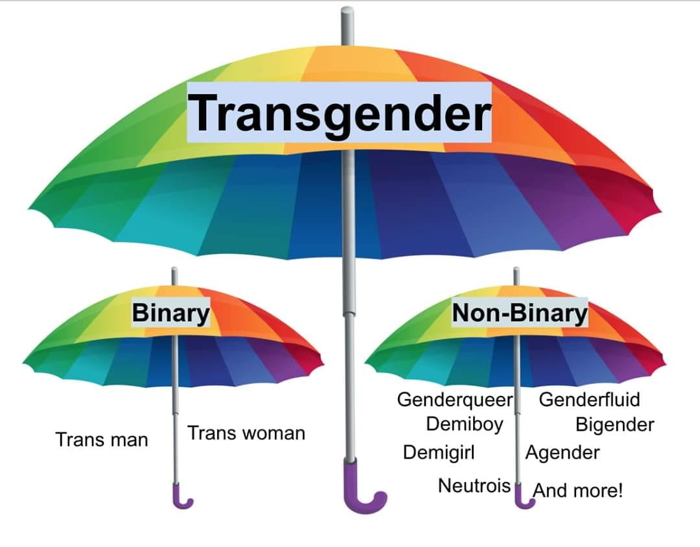
Several times in several different groups somebody has asked about the difference between "transgender" and "genderqueer" and "nonbinary" and then somebody else has posted something like this:


I don't like that illustration.

So what's my problem with it?

I identify as genderqueer and I do not identify as transgender, and that umbrella diagram sticks me into that category whether I like it or not. That diagram creates a hierarchy in which all genderqueer people are transgender (but not vice versa). That means that any statement that transgender people make on behalf of all trans people is going to be considered to apply to me and other people like me. Because we're defined as being under that umbrella.

Let's look at some of the broad all-inclusive statements that many transgender people have made, shall we?

a) A person's gender identity is valid regardless of their physical anatomy. You don't have to have a medical transition in order for your gender identity to be valid. You don't have to "pass" in order for your gender identity to be valid

Well, that one is wonderful, I'm totally on-board with that! It used to be that society's understanding of what it meant to be trans was that you went out and got yourself a medical transition to make your physical anatomy correspond with your gender identity. And that certainly didn't describe me! So this is a good change, a good shift. The problem is with additional assumptions and assertions that they very often attach to that, such as

b) A person's physical anatomy is not a polite topic of consideration. Anatomy is utterly irrelevant to identity and nobody's business. It's totally inappropriate to be identifying a person on the basis of what's inside their underpants

and...

c) You should not use any anatomy-based terms except to refer to the binary sex assignment that our society coercively attributes people to at birth. If someone identifies as a woman or girl, you would be misgendering them if you did not consider them female; if someone identifies as a man or boy, to not regard them as fully male is transphobic and misgendering also

and...

d) Any insistence that sex and gender are two different things is politically offensive and based on wrong out-of-date science that is now disproven. There's no such thing as "biological sex" because intersex people exist and there are multitudes of body variation from chromosomes to organ structures, so the binary is just a social construct and there is no physical sex.

Well, let's unpack some of that. (Because we don't all wear the same packers in here, okay?) In reverse order, my intersex-activist buddies do want to make a distinction between sex and gender. It's important to them and they're tired of "intersex" being used as an argument for why "biological sex doesn't exist" and otherwise ignored. Intersex people have bodies. They have bodies that other people found embarrassingly different. So embarrassing that they often coercively assigned their bodies to male or female with a surgeon's knife, without their consent. Intersex people can't discuss the fact that their body differed at birth from the body of either male people or female people if "male" refers to gender identity instead of physical sex. Intersex people can't identify themselves if people in society are confused and say things like "Oh me too, I've always had a female side, I wanted to dance ballet instead of play baseball". I'm not intersex myself, but I can't even explain that I'm not intersex if the language doesn't let me explain that although I was never a boy or man, my physical configuration wasn't unusual for male people. That it's my gender that's queer, that my sex falls into normative classifications.

I identify as a femme or girl. But unlike Teresa, my transgender sister, I would not be misgendered if you called me male. Teresa would be; she'd find it insulting and demeaning. She identifies as a woman and definitely female. But I'm not Teresa. I identify as male. I identify as femme or girl. My sex and my gender don't match. I'm genderqueer. And if you're going to raise a giant umbrella over my head and say we're all transgender, you can't go around making blanket statements that support Teresa's identity but erase mine.

If it is no longer necessary to "pass", to look like a typical cisgender person of your same gender, then it should not matter if people do make some guesses about what's inside my underwear. Because no matter what's in there, we already agreed that it doesn't invalidate my gender identity, right? So it doesn't have to be kept a shameful secret. I've got the anatomy that most directly caused my mom's obstetrician to designate me as "male". It's an unfortunate social fact that the same anatomy also caused my birth announcements to incorrectly tell everyone "It's a boy!", but the "male" part wasn't wrong and I have no reason to hide it. I was a male girl. Perfectly queer and not typical, and quite healthy and happy with that, thank you.

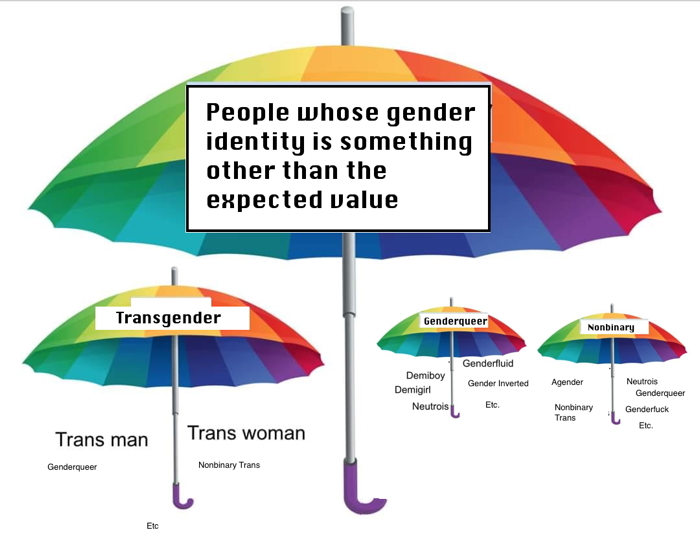
I propose this umbrella instead:


Notice that under this umbrella, several terms appear in multiple places. Because some genderqueer people do identify as transgender, whereas some do not; similarly some nonbinary people identify as transgender and others do not, and some nonbinary people consider themselves genderqueer while others do not, and vice versa and so on.


———————

You're secluded in quarantine, and all the performances and events have been cancelled, so it's a good time to read a book!

My book, GenderQueer: A Story From a Different Closet, has been published by Sunstone Press. It is available on Amazon and Barnes & Noble in paperback and ebook, and as ebook only from Apple, Kobo, and directly from Sunstone Press themselves.


Links to published reviews and comments are listed on my Home Page

———————

This DreamWidth blog is echoed on LiveJournal, WordPress, and Blogger. Please friend/link me from any of those environments on which you have an account.

————————


Index of all Blog Posts
ahunter3: (Default)
Like most people born with a penis and testicles, I was AMAB: assigned male at birth.

I don't refer to myself as transgender because I don't seek to be perceived as a female person. And I don't tend to identify as nonbinary because I don't seek to be perceived as someone who is neither male nor female.

I identify as genderqueer and, more specifically, as a gender invert.

* * *

There are a lot of ongoing discussions, especially within the trans communities, about how you don't have to be on hormones, don't have to get an operation, to be valid as a transgender person. About how the legitimacy of one's identity as transgender does not depend on changing one's body.

The ones who do — the people conventionally designated as "male to female" or "female to male" — are nowadays often referred to as "binary transgender". And the assertion that you don't have to be binary trans in order to be authentically trans is an affirmation of nonbinary transgender identities.

The fact that there are so many posts and statements saying so is a clear sign that a lot of people think "transgender" means that if you were assigned male at birth you wish to be perceived as female, accepted as a woman, not differentiated from cisgender women, that you present as female, that you do everything at your disposal to do so successfully, that you seek to pass. And reciprocally the other way around if you were assigned female at birth.

That's what the term "transgender" means to a lot of people out there, both within the trans community itself and in the mainstream.


Hello. I am a person who could identify as a "nonbinary transgender" person.

I don't choose to do so. I don't feel like it communicates. I feel like it just confuses people. They make one set of wrong assumptions when they see me and mentally assign me as a male person. If I tell them I'm transgender they make a different set of wrong assumptions and I'm no better off.

Meanwhile, out there are a bunch of male-to-female and female-to-male transgender folks. A handful of them are "truscum" or "transmedicalist" and don't consider anyone to be authentically trans unless they seek a medical transition. Then there are quite a few more who don't have that kind of absolute judgemental definitional thing going on, but who will admit to missing the days when the only kind of trans people were binary trans. I'm not going to say they're right, especially since so many of my friends and colleagues identify as nonbinary transgender. But I have to confess, I sympathize with them and their viewpoint. Many of them have been around as long as I have. That means they lived through decades when most of society had only heard dirty jokes and porn references to trans people. And some of them feel like they did the hard work to get transgender issues in front of the social consciousness and now all these newfangled nonbinary trans people want to be a part of the phenomenon.

There's a reason why there aren't more people identifying as I do, as gender invert. It's because they haven't heard the term. Nobody offered it to them as an option to consider. So they went with "transgender". Or "nonbinary". Or "nonbinary transgender".

But what if you were assigned male at birth, you consider your body to be, in fact, male, but your gender isn't masculine, isn't man, isn't guy, isn't boy, that instead you are femme, one of the girls? Or if you were assigned female at birth, recognize your body to be female, but have never been a girl or a woman, and instead you're all man, all guy, all boy, totally a masculine individual?

If you say "transgender" and folks know you were AFAB they'll almost universally assume you identify as "male". If you say "transgender" and they understand you were AMAB, they'll assume you to identify as "female".

Specifying "nonbinary transgender" just shifts the problem. Now people are likely to assume that you don't want to be identified as any named sex or gender. That you're declaring yourself to be neither male nor female, neither man nor woman.

If what I'm saying resonates for you, you're welcome to come join me as a gender invert instead.


———————

You're secluded in quarantine, and all the performances and events have been cancelled, so it's a good time to read a book!

My book, GenderQueer: A Story From a Different Closet, has been published by Sunstone Press. It is available on Amazon and Barnes & Noble in paperback and ebook, and as ebook only from Apple, Kobo, and directly from Sunstone Press themselves.


Links to published reviews and comments are listed on my Home Page

———————

This LiveJournal blog is echoed on DreamWidth, WordPress, and Blogger. Please friend/link me from any of those environments on which you have an account.

————————


Index of all Blog Posts

January 2026

S M T W T F S
    1 23
45678910
11121314151617
18192021222324
25262728293031

Most Popular Tags

Syndicate

RSS Atom

Style Credit

Page generated Jan. 8th, 2026 03:37 pm
Powered by Dreamwidth Studios