Expand Cut Tags

No cut tags
ahunter3: (Default)
As author of autobiographical nonfiction, I'm occasionally questioned and challenged about my recall. I even once had a potential publisher tell me I could not market my book as nonfiction at all, since human memory is so unreliable!

That's an extreme position, and hence pretty easy to dismiss, but to a lesser extent the question has come up in various ways several times.

I do appear to have an unusually good recollection of events in my own life, but another factor involved here is that I've often written about things that happened to me, the events that had an impact on me at the time. That means that when I sit at my computer to write in the 2020s about something that happened to me in the 1980s, it's typically something I've written about previously. That works on two levels: the previous act of prowling through those memories and pondering them in order to write about them probably keeps them fresher than if I hadn't thought about them much in the intervening years, and in many cases I have copies of what I actually wrote at earlier points.

Within the Box has a couple pages of description of my first incarceration, in 1980, as a student at the University of New Mexico.

Here is a portion of that, followed by a snippet or two of an earlier description of the event from 2003 and one from a yet earlier description I wrote in 1982.


I dealt with Mountain View by starting my own local chapter of Mental Patients’ Liberation Front, and even though they were utterly coercive and we had no rights to speak of, I managed to get most of the patients in agreement that we should listen to each other and be mutually supportive, and try to ignore the horrible treatment the institution was subjecting us to. And I also got the support of a significant percent of the staff members, to the point that it polarized the institution and disrupted its functioning. I was making sense to a lot of people, and making their jackbooted authoritarian ways look silly and indefensible. Upper echelon clinical staff eventually decided I was a rabble raising psychiatric rights activist and booted me out, as if they’d caught me trespassing.

(from Within the Box, "Day Eleven" chapter)


So I make friends with the other mental patients. I’m thinking initially “I don’t belong here this is a mistake”, like most of you probably would, but the other mental patients here on the Seriously Disturbed Ward…umm, they don’t think they’re Napoleon and they aren’t seeing pink elephants and I can talk to them. Heck, I can even explain the stuff in my papers that got me into this place and they understand it (with varying shades of disagreement or ideas about what some things would mean that don’t overlap with my own). And I can understand the stuff that they are wrapped up in and concerned about...

After a week or so, we have started calling ourself the “patient people” instead of “patients” because to survive in this place you need to be very patient with the confrontational and abusive staff who belittle you and order you around, and patient with the situation in which you’re locked up and when not in immediate danger from the psychiatric professionals are generally bored. And we start referring to the staff when they behave at their worst as “impatient people”. We continue listening to each others’ stuff and give each other reality-checks and confirmations of the authenticity of feeling this or that based on what has happened to us here or there, and give each other pragmatic advice and sympathy and just someone to talk to about it. And pretty quickly we’re overtly saying that the only therapy in this place is what we are providing to each other. There are a couple of nurses, one in afternoon shift and another on night shift, who applaud this and say it is excellent. There are others on both of these shifts and everyone on the morning shift who regard it as inappropriate behavior and try to discourage us from talking to each other. The woman whose husband put her in there has a doctor who starts issuing instructions to the staff to stop this behavior. My doctor is mildly supportive but mostly for what he thinks it means regarding me individually. He thinks this is all my doing. At first it sort of was except that it caught on like wildfire once some of this stuff had been said out loud once or twice. There is another doctor who thinks the whole phenomenon is a great success story for “milieu therapy” which usually means “the therapeutic advantages of being surrounded by walls and barred windows” but now because we are essentially doing mutual therapy (and not assuming each other to be “sick”, by the way) we are part of each other’s “milieu” …at any rate he thinks it’s all wonderful and is instructing his patients to participate in our home-grown group sessions.

By the fourth week the staff is openly bickering, not just in the conference room behind the nurse’s station but in front of us out on the ward floor, and we’re behaving like calm patient little Zen masters. One guy hooks up the teenage couple with an attorney friend he knows and although he won’t “take their case” he gives them simple legal advice. I flirt with the married woman in front of her husband when he comes to visit and we imply to him that the two of us are having an affair in the hospital and he suddenly starts saying he’s going to talk to the doctor about her coming home. The guy with the Jesus freak parents is drawing his nightmare visions in crayons and it seems to help him cope and for crayon drawings they are pretty good.

Then one day I’m out in the barbed-wire enclosure (“yard”) where they let the patients go to smoke and get sunlight and when I come back in I find all my stuff is piled in the middle of the intake corridor and they won’t let me go onto the floor. “You aren’t crazy and you can’t stay here. You have to leave. Take your stuff and get out of here.”


(from a message board post, 2003)


...[I]nto the modern shiny psychiatric institution was tossed a stranger who had been handing out strange feminist manifestos, and he had just recently read an article about a group of psychiatric inmates calling themselves Mental Patients' Liberation Front, so when he deciced he wasn't getting what he'd come for, he decided to start a chapter right there in the hospital.

And the members of this new Mental Patients' Liberation Front wanted to talk about sex and politics and religion and love and suicide and life and death; and some of them wanted to sleep with each other while others wanted to sleep on the couches or on the floor, and they said, "So what if it it's emotionally intense, or unorderly, or different from normal? Does it hurt anything?" They complained about the godawful boredom, and some of the women put their makeup on their boyfriends while the men giggled, and the men shaved their eyebrows instead of their cheeks while the head nurse scowled from his plexiglass office.

In group therapy, the patients, now calling themselves the patient people, began discussing and redefining values. The nurses who had come to beam parentally and guide the therapy were told they could join in or listen patiently, but not to interfere impatiently with the patient people talking; after awhile, some of the nurses started talking, too.

But there were also a lot of very threatened and insecure people there who didn't like their reality tested like that, and they yelled, became violent, and insisted that personal contact was psychologically damaging to their patients' well-being. The patient people insisted otherwise, but the fearful ones lost their patience as rapidly as they were losing their patients, no matter how patient the patient people tried to be with them. Psychotropic tranquilizer drugs were ordered all around. It didn't look good for the patient people.

But some of the other therapists and an administrator or two began speaking up for the patient people, saying that these outspoken patients had an interesting set of ideas about reorganizing the care plan procedure of the institution. Some of them even went so far as to say that they didn't think the patient people were crazy at all.

Until one day a fiery MPLF radical or two found all personal possessions stacked in piles on the corridor floor after returning from weekend pass:

"You can't stay here any more. No, you can't talk with any of the other patients. Get your stuff off our floor and leave. If that stuff is still here tonight, it goes outside into the street."


(from The Amazon's Brother, unpublished, written in 1982)


—————


My first book, GenderQueer: A Story From a Different Closet, is published by Sunstone Press. It is available on Amazon and Barnes & Noble in paperback, hardback, and ebook, and as ebook only from Apple, Kobo, and directly from Sunstone Press themselves.


My second book, That Guy in Our Women's Studies Class, has also now been published by Sunstone Press. It's a sequel to GenderQueer. It is available on Amazon and on Barnes & Noble in paperback and ebook, and as ebook only from Apple, Kobo, and directly from Sunstone Press themselves.

I have started querying my third book, Within the Box, and I'm still seeking advance readers for reviews and feedback. It is set in a psychiatric/rehab facility and is focused on self-determination and identity. Chronologically, it fits between the events in GenderQueer and those described in Guy in Women's Studies; unlike the other two, it is narrowly focused on events in a one-month timeframe and is more of a suspense thriller, although like the other two is also a nonfiction memoir. Contact me if you're interested.


Links to published reviews and comments are listed on my Home Page, for both published books.

———————

This DreamWidth blog is echoed on LiveJournal and WordPress. Please friend/link me from any of those environments on which you have an account.

————————


Index of all Blog Posts
ahunter3: (Default)
Lit agents and publishers often release (or make posts to) a Manuscript Wish List. I figure turnabout is fair play, don't you?

Let's start with the notion that we, as authors, are supposed to select the lit agents that we really want to work with, and not just spew query letters at random to anyone who appears to be a lit agent with a pulse.

You go to web sites that aggregate information about lit agents (such as querytracker or agentquery) and they'll tell you that an agent named (let's say) Susan Jones represents general fiction, sci fi, romances, suspense, thrillers, mysteries, other genre fiction, historical nonfiction, popular science nonfiction, memoirs, how-to guides, self-help health and therapy; and is accepting queries, prefers them via email.

You go to individual lit agents' own web sites such as susanjones.com to find out more about this lit agent and you learn that what she's really interested in are books that you can curl up in bed with and lose track of time, books that feature brave heroines or nontraditional heroes in quirky new settings, stories with a modern punchline that adds a new twist to old wisdom, or books that make her think. And she has two poodles and an aging cat and likes lasagna and wears flannel in the wintertime. And by the way, the Susan Jones Literary Agency had the privilege of representing THE CAGE AND THE KEY by Joe Johnson, MY PASSAGE THRU THE UMBILICAL CORD by Terry Truwrite, FIFTY KEY BILLS AND HOW THEY TIED UP THE SENATE by Senator C. D. Politician, RHODESIA SONNET by Jane Goodwriter, and nineteen other titles I haven't read or heard about by authors I haven't read or heard about, although some of these sound like books I should add to my reading list.

So...

Dear Susan Jones,

What I'd really like to know about you and all the other lit agents that would tell me whether I should query you soonest or only later as a last resort:

* Of the books you have taken on, what percent of them got placed with major publishing houses that invested in publicizing the book?

* Please describe the changes that you've requested authors to make to their manuscript. Have you tended to request the addition or subtraction of a character? The addition or subtraction of a major plot element or theme? Have you suggested extensive edits to improve readability and smoothness and continuity? Cleaned up typos, spelling errors, grammar errors, run-on sentences and the like? How often have you ended up in protracted arguments with your authors about the changes you've requested?

* What are the most annoying behaviors you've encountered from the authors you've worked with? Are there any attitudes or habits or tendencies that really drive you up the wall, such that you wish you'd known about them in advance and had avoided those authors? How did you handle it?

* What is your success rate at negotiating the details of the contracts with the publishers to the satisfaction of your authors? Are there things that authors tend to want (e.g. retention of film rights, subsidiary rights, foreign rights) that you've had difficulty obtaining? If so, from which types of publishers?

* How often have you contracted to represent an author and then were unable to place their book for publication for more than 5 years? 8 years? How often have you reverted the rights or rescinded the contractual arrangements due to inability to place the book (or the author's impatience with you doing so)?


—————


My first book, GenderQueer: A Story From a Different Closet, is published by Sunstone Press. It is available on Amazon and Barnes & Noble in paperback, hardback, and ebook, and as ebook only from Apple, Kobo, and directly from Sunstone Press themselves.


My second book, That Guy in Our Women's Studies Class, has also now been published by Sunstone Press. It's a sequel to GenderQueer. It is available on Amazon and on Barnes & Noble in paperback and ebook, and as ebook only from Apple, Kobo, and directly from Sunstone Press themselves.

I have started querying my third book, Within the Box, and I'm still seeking advance readers for reviews and feedback. It is set in a psychiatric/rehab facility and is focused on self-determination and identity. Chronologically, it fits between the events in GenderQueer and those described in Guy in Women's Studies; unlike the other two, it is narrowly focused on events in a one-month timeframe and is more of a suspense thriller, although like the other two is also a nonfiction memoir. Contact me if you're interested.


Links to published reviews and comments are listed on my Home Page, for both published books.

———————

This DreamWidth blog is echoed on LiveJournal and WordPress. I was going to start echoing it on Substack as well but we're not off to a good start. Anyway, please friend/link me from any of those environments on which you have an account.

————————


Index of all Blog Posts

Audiobook

Dec. 3rd, 2022 05:26 pm
ahunter3: (Default)
A handful of my friends and associates have told me they bought copies of my book but for various reasons (visual impairment, dyslexia, etc) they find it difficult to read anything book-length. "Is it available as an audiobook?", they've asked.

My publisher, Sunstone Press, has never discussed the possibility of either of my books being released in audio format, but I've read selections out loud at several author's presentations (discussion groups, book clubs, library featured author events, etc) and I got to thinking -- I have decent recording software available to me (I'm a musician after all), so I could record myself reading my own books out loud easily enough.

I decided to proceed with that. I figured I'd get feedback from the friends who had told me reading my book was a problem for them, and if they say my voice is sufficiently clear and easy to understand, I'll contact the publisher and see if they're interested.

That puts the audiobook format of the book only into the hands of people who already bought the paperback, so they shouldn't object, and they might wish to make it officially available for others who'd prefer an audio copy.


I'm using Sound Studio, a basic but reliable shareware product from Felt Tip that reminds me of the old Macromedia SoundEdit 16 I used back in the 1990s. Designate the input source (I use the Logitech USB headphones that I use for Zoom and softphone purposes, it has a good microphone optimized for speech purposes), click the Record button, and begin narrating.

Now and then I stumble. I make a mushy inarticulate rendering of a word, or I accidentally skip a line or insert a word that doesn't belong or leave one out... I hit the stop button. The sound wave patterns of what's been recorded up until then are on the screen in front of me, and although I can't look at the wave patterns and discern exactly what sounds they represent, I've learned the basics. I can tell where a phrase or sentence likely begins, highlight it, and play it back to be certain, verify that yep, as I thought, I made an utter hash of that, then open a new window, record just that little bit, copy, switch to the main window, delete what I've got selected, paste, then go back and replay it to make sure I've done it better the second time.

The book I'm working on is the first, GenderQueer: A Story From a Different Closet. Typical chapters are 30-45 minutes, although it starts off with a couple short ones and will end with a short one.

I save as I go, in full-quality uncompressed AIFF format. Then I do a playback, listening through the headphones, stopping whenever some section seems lacking in enunciation and clarity, and again re-recording the snippet and pasting in a better replacement.

Sound Studio lets me fill in MP3 tags (track title, artist, track number out of how many total tracks, album name), so I do all that (using book name for album name, author name for artist, etc) and then do a Save As and save the file in MP3 format.


It took me a long time to appreciate my speaking voice. Nobody's voice sounds to them on a recording the way their voice sounds inside their head when they're speaking. The resonances you hear from within your skull aren't the same as the resonances that go out into the room. My recorded voice always sounds more hesitant and less clear, and thinner, than I think I sound. To me, when I'm listening to recordings of myself speaking, I sound like all the words run together as a sound puddle asifIwasn'tproperlypausingoremphasizingwhereonewordstopsandthenextwordbegins. Fortunately, that part, at least, is better when I'm reading from something that's written down, including my own work. I also had a challenge getting used to the tone of my recorded voice. The timbre of it is strange. My trans women friends are jealous, because I get ma'amed on the phone by default and I've never made any effort in that direction, it's just how people gender my voice when they hear it and don't have the visual of the bearded tall person with a prominent larynx in front of them to offset that impression.

I've done the first seven chapters, with ten more to go.

—————


My first book, GenderQueer: A Story From a Different Closet, is published by Sunstone Press. It is available on Amazon and Barnes & Noble in paperback, hardback, and ebook, and as ebook only from Apple, Kobo, and directly from Sunstone Press themselves.


My second book, That Guy in Our Women's Studies Class, has also now been published by Sunstone Press. It's a sequel to GenderQueer. It is available on Amazon and on Barnes & Noble in paperback and ebook, and as ebook only from Apple, Kobo, and directly from Sunstone Press themselves. Hardback versions to follow, stay tuned for details.


My third book is in post-first-draft corrections and is being circulated to beta readers for feedback. Provisionally title Within the Box. Contact me if you're interested.


Links to published reviews and comments are listed on my Home Page, for both published books.

———————

This DreamWidth blog is echoed on LiveJournal and WordPress. Please friend/link me from any of those environments on which you have an account.

————————


Index of all Blog Posts
ahunter3: (Default)
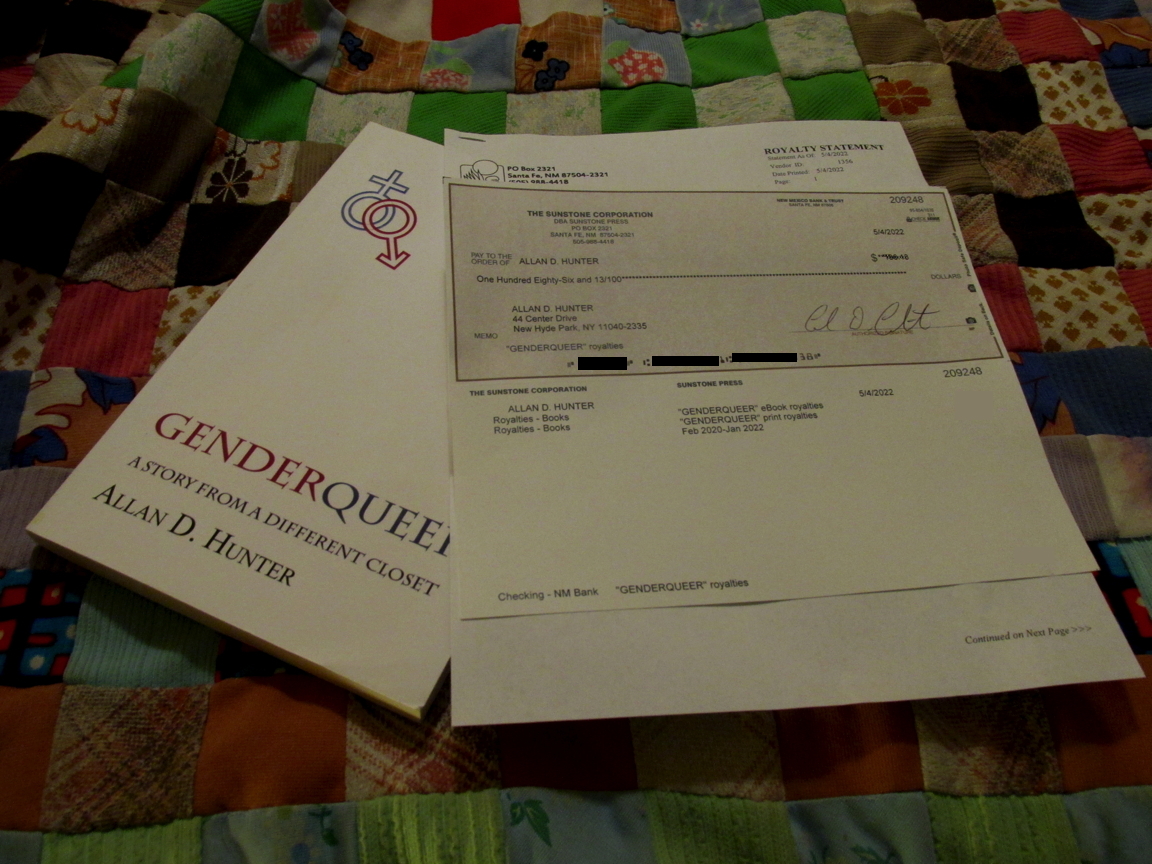
I won't be quitting my day job, but it was nice to have this arrive in yesterday's mail.


Fledgling authors get warned a lot about discouragement and despair in the querying and submitting phase, and I would still consider that to be the hardest and most demoralizing slog to get through. But if, like me, you get published by a small publisher that's in no position to do promotion and marketing and advertise your book, you'll most likely face a second discouraging phase once it's actually in print and it seems like no one is reading it.

My sales didn't take off like a skyrocket, going ever-higher and higher, but they also didn't hit an initial max as all my blog readers and followers and friends obligingly went out and bought a copy and then plummet afterwards. Instead, I got a sawtooth of good sales periods interrupting the doldrums and a gradual accumulation, ultimately doing nearly twice as well as I thought I was doing. Later, I'll do an analysis to see if (as expected) the upticks in sales corresponded to when I did author readings or had new ads out.

This is for the first book, GenderQueer: A Story From a Different Closet. In the most recent months reported, sales have fallen off as my attention (and blogging and advertising) has mostly focused on the second book. But I'm releasing combo ads that tout the two books as a continuing tale (which is true) so maybe that will fuel another good month or two for the first book.


—————


My first book, GenderQueer: A Story From a Different Closet, is published by Sunstone Press. It is available on Amazon and Barnes & Noble in paperback, hardback, and ebook, and as ebook only from Apple, Kobo, and directly from Sunstone Press themselves.


My second book, That Guy in Our Women's Studies Class, has also now been published by Sunstone Press. It's a sequel to GenderQueer. It is available on Amazon and on Barnes & Noble in paperback. eBook version and hardback versions to follow, stay tuned for details.


Links to published reviews and comments are listed on my Home Page, for GenderQueer now and for Guy in Women's Studies once they come out.

———————

This DreamWidth blog is echoed on LiveJournal and WordPress. Please friend/link me from any of those environments on which you have an account.

————————


Index of all Blog Posts
ahunter3: (Default)
That Guy in Our Women's Studies Class
is now in print and available for ordering (amazon link; other purchase links listed farther downscreen)


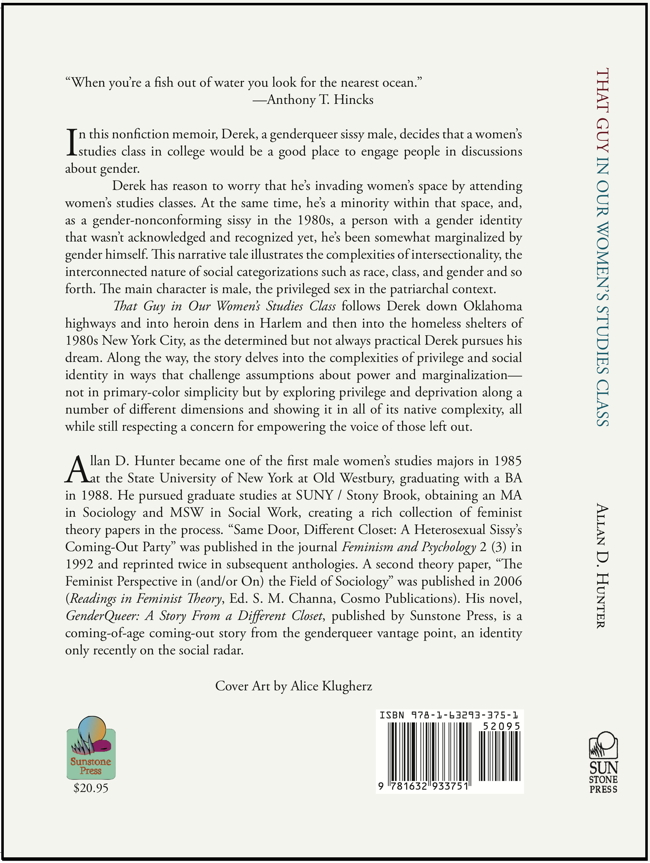
In this nonfiction memoir, Derek, a genderqueer sissy male, decides that a women's studies class in college would be a good place to engage people in discussions about gender. Derek has reason to worry that he's invading women's space by attending women’s studies classes. At the same time, he's a minority within that space, and, as a gender-nonconforming sissy in the 1980s, a person with a gender identity that wasn't acknowledged and recognized yet, he’s been somewhat marginalized by gender himself. This narrative tale illustrates the complexities of intersectionality, the interconnected nature of social categorizations such as race, class, and gender and so forth. The main character is male, the privileged sex in the patriarchal context. The story follows Derek down Oklahoma highways and into heroin dens in Harlem and then into the homeless shelters of 1980s New York City, as the determined but not always practical Derek pursues his dream. Along the way, the story delves into the complexities of privilege and social identity in ways that challenge assumptions about power and marginalization--not in primary-color simplicity but by exploring privilege and deprivation along a number of different dimensions and showing it in all of its native complexity, all while still respecting a concern for empowering the voice of those left out.


Guy in WS is a somewhat rare thing in autobiographical nonfiction: a sequel! It picks up where GenderQueer left off: Derek (me) has just come out as a self-described sissy and seeks to be an activist in 1980, an era long before modern LGBTQ identity politics, and decides academic women's studies is the place to discuss such matters and meet other people wanting to do the same.

As a women's studies student, I arrive as a male, a guy -- regardless of how I identify, that's how I am perceived and treated, with both misgendering and privileges included. And women's studies in the 1980s is a space that's intrinsically critical of male hegemony and male behavioral patterns. As part of the "Q" in LGBTQ, I'm an outlier in this tale, an identity not yet spoken for, a sissy in a world rife with sissyphobia. The new discourse of women's studies was not designed with people like that in mind. Meanwhile, I'm not only perceived as male, but also recognized and viewed as while, educated, and imbued with the privileges of the professional middle class, invoked by how I speak and how I behave.

It is first and foremost my own tale, but it's also a good Exhibit A for discussions of intersectionality and the complexities of privilege and marginalization.

It's my fondest hope that people who read it will say of it that it's that book that "will make you think".


Well, I guess at this point that's a subset of the main hope, which is that people will read it and review it!


Additional relevant links:

Barnes & Noble, alternative purchase for people averse to Amazon

(It can also be acquired from various small independent booksellers).

Library of Congress listing

Goodreads listing

A pair of color ads I'm going to be running:

Step One: Coming Out

Step Two: Going Forth


—————
Links to published reviews and comments are listed on my Home Page

———————

This DreamWidth blog is echoed on LiveJournal and WordPress. Please friend/link me from any of those environments on which you have an account.

————————


Index of all Blog Posts
ahunter3: (Default)
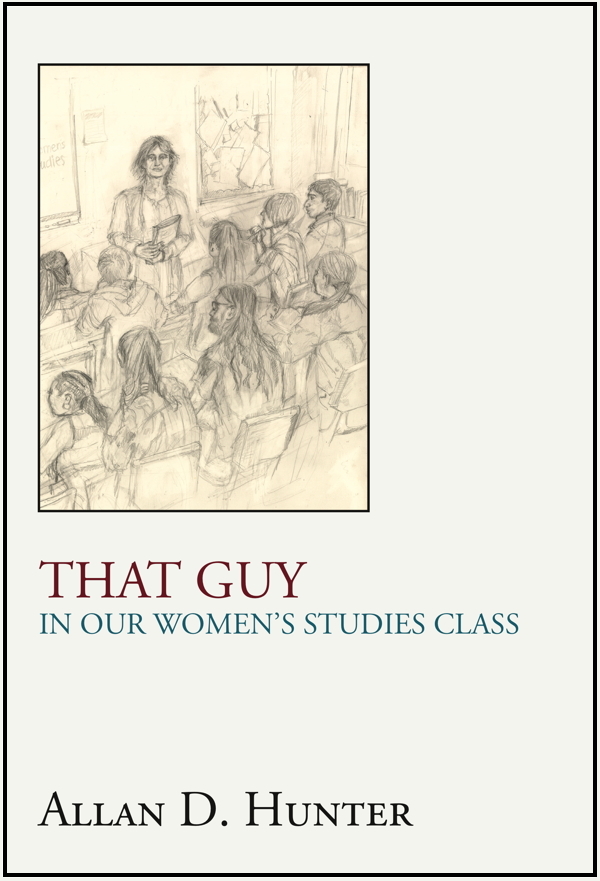
Say hi to book #2!!


My close friend Alice Klugherz did the cover art for me. Font and text colors match those used in the first book, which fits since the story is a continuation of the same narrative.

That Guy in our Women's Studies Class is a rare thing in the world of memoirs: a sequel. In March 2020, my book GenderQueer: A Story From a Different Closet was published by Sunstone Press (Santa Fe NM).

GenderQueer told the coming-of-age and coming-out story of realizing I had a different gender identity and of giving it a name. At the end of it, I vow to confront the world about how sissy males are treated. In That Guy in our Women's Studies Class, I set out to do exactly that, choosing the world of academic women's studies as my platform.

I don't have an official release date yet, but the publisher says "soon".


Here's the back cover and spine:


Here's the CIP block as it will appear when you turn the page:

© 2021 by Allan D. Hunter
All Rights Reserved
No part of this book may be reproduced in any form or by any electronic or mechanical means including
information storage and retrieval systems without permission in writing from the publisher,
except by a reviewer who may quote brief passages in a review.
Sunstone books may be purchased for educational, business, or sales promotional use.
For information please write: Special Markets Department, Sunstone Press,
P.O. Box 2321, Santa Fe, New Mexico 87504-2321.
Printed on acid-free paper
eBook 978-1-61139-658-4

Library of Congress Cataloging-in-Publication Data

Names: Hunter, Allan D., 1959- author.
Title: That guy in our women’s studies class : a novel / by Allan D.
Hunter.
Description: Santa Fe : Sunstone Press, [2022] | Summary: “A personal
memoir of a genderqueer male seeking a political platform within
collegiate women’s studies programs in the era before modern
gender-identity politics”-- Provided by publisher.
Identifiers: LCCN 2022001491 | ISBN 9781632933751 (paperback) | ISBN
9781611396584 (epub)
Subjects: LCSH: Hunter, Allan D., 1959- | Gender-nonconforming
people--Biography.
Classification: LCC HQ77.8 .H86 2022 | DDC 362.897092--dc23
LC record available at https://lccn.loc.gov/2022001491


corresponding LiveJournal post: https://ahunter3.livejournal.com/91002.html
ahunter3: (Default)
BookArrives01


BookArrives02

There's nothing quite like holding the actual physical printed book. Finally! I'm a published author now.

Showing my age, I suppose, but somehow having an eBook to send out as an Advance Review Copy (ARC) doesn't seem much different from just printing the book out to PDF and mailing it to a potential publisher or lit agent.

It is utterly gorgeous. Kudos to Sunstone Press. High quality physical materials, really nice cover, good paper, solid-feeling construction. It feels like something that will survive on library shelves and hold up to being tossed into backpacks and knapsacks and whatnot.


Ten years ago I began writing what would eventually become GenderQueer. (I started trying to get it published in 2013)

Forty years ago I came out on UNM campus — the climactic event in the book. Long before there was any such term as "genderqueer" I described to people how the person I was inside was basically the same persona as what's more typical of girls and women, that this made me different in the same general way that gay and lesbian folks were different, but that it was something else. Not trans, either (I was physiologically male, and that wasn't the problem). I invented my own terms, created my own symbols, wrote my own manifestos and began dealing with the insinuations and innuendos and hints by dropping my own coy allusions and double-entendres into conversations, unworried about whether people could parse them or not, confident, finally, of who I was, what I was, how I was. Let other people be uncomfortable with it if they must, but I'm done with that.


I've been reviewed in a handful of college newspapers with more promised to come, and a couple have been entered on GoodReads. Amazon isn't allowing reviews to be posted until the official release date (I guess?) (3/16/20) and I don't yet have any reviews in commercial or LGBTQ publications but expect those to start appearing as well. Haven't placed any ads yet (aside from a blog tour package) but we're designing them and I do have an ad budget.

I've heard it said that this is a good time for folks to stay indoors and avoid the crowds and curl up with a good book. Read mine! Then, if you liked it, recommend it to your friends.

It's a different story than any you're likely to have read, and I want folks to hear it.


———————

My book is being published by Sunstone Press, and is now available on Amazon and now on Barnes & Noble

(paperback only for the moment).

———————

This LiveJournal blog is echoed on DreamWidth, WordPress, and Blogger. Please friend/link me from any of those environments on which you have an account.

————————

Index of all Blog Posts
Home Page
ahunter3: (Default)
The Whitman Wire, student newspaper of Whitman College (Walla Walla WA) has published a review of GenderQueer!


“GenderQueer: A Story from a Different Closet” explores the complexity of gender


Because I figured that my book would be of particular relevance to the college communities, both students and faculty, I solicited reviews from student newspapers. The Whitman Wire is the first to publish a review of my book.

I am very happy with the column, written by Jaime Fields, their Arts & Entertainment reporter. It's an analysis of the writing itself, including character development and pacing and readability (she compares it favorably to fiction novels and describes it as "compelling and enjoyable to read"), of the story line, and of the book's social relevance to potential readers.

I'm particularly pleased that the review characterizes the book as being intense and verging on overwhelming. After a long querying odyssey in which I was told over and over by literary agents and publishers that the writing didn't move them, that it left them wanting to know more about what my character was feeling, that it was dull, static, and lacked emotion *, it is nice to read that my book actually packs an emotional punch!


* e.g., Jason Bradley, editor at NineStar, with whom I had a publishing contract for this book back in 2017. Backstory available here

———————

My book is scheduled to come out March 16 from Sunstone Press, and is now available on Amazon for pre-orders (paperback only for the moment).

———————

This LiveJournal blog is echoed on DreamWidth, WordPress, and Blogger. Please friend/link me from any of those environments on which you have an account.

————————

Index of all Blog Posts

Home Page
ahunter3: (Default)
There's been a delay -- my book will not, as previously indicated, come out in January -- but I do now have an official release date! GenderQueer: A Story from a Different Closet will be published by Sunstone Press on March 15, 2020.

Front Cover


So here's what the delay is about: if you pick up a nonfiction book, you're likely to see a block of text on the copyright and dedication page that tells you how the Library of Congress has categorized the book. Libraries and other institutions make use of this.

It's called a "CIP Block".

Here, for example, is the CIP Block for the book Guns, Germs and Steel by Jared Diamond:


Library of Congress Cataloging-in-Publication Data
Diamond, Jared M.
Guns, germs, and steel : the fates of human societies / Jared Diamond.
p. cm.
Includes bibliographical references and index.
ISBN-13: 978-0-393-31755-8
1. Social evolution. 2. Civilization—History 3. Ethnology. 4. Human being—Effect of environment on. 5. Culture diffusion I. Title
HM206.D48 1997
303.4—dc21 96-37068
CIP
W W Norton & Company, Inc. 500 Fifth Avenue, New York N.Y.10110
www.wwnorton.com
W.W.Norton & Company Ltd., Castle House, 75/76 Wells Street, London, W1T3QT


Sunstone Press is a publisher that does release nonfiction books that are purchased by libraries and is therefore a participant in the Cataloging in Publication program. More info.

Since I hope for my book to be acquired by libraries and to become assigned reading for women's and gender studies programs at colleges, it seems very much in my best interests to have my book enrolled and given a CIP block.

Well, the Library of Congress apparently doesn't always move with great alacrity when a publisher sends in a manuscript. And that's what the wait has been about.

Between now and March 15, I should be getting a listing on Amazon for advance orders. I'll keep y'all informed.


———————

This LiveJournal blog is echoed on DreamWidth, WordPress, and Blogger. Please friend/link me from any of those environments on which you have an account.

————————

Index of all Blog Posts

Home Page
ahunter3: (Default)
Having given approval to the formatted manuscript and the covers (back and front), I've now effectively switched effort-gears from "getting book published" to "getting people to read the book", even though it hasn't rolled off the Sunstone Books presses yet.

At this phase, where the book's availability is predicted but still slightly off in the future (January 2020, for benefit of the curious), the focus is on women's and gender studies programs at colleges, and LGBT community centers. I can be booked to speak at such venues even before it's possible to show up with a stack of the books on the table in front of me.

I actually did some of that in 2016-2017 when I had previously thought my book was on the verge of coming out. I thoroughly enjoyed the experience. Learned a lot, too. When I next have an opportunity to present, the presentation is going to be more closely focused on my specific type of gender identity and what it brings to the table. People like the "Gender 101" introductory material but I think I can encapsulate it in a much smaller portion of my talk.

Later, once the book can be purchased, I will add libraries and bookstores to the list of targets.

To be sure, a library or a bookstore, theoretically speaking, could also have a presenter or speaker before their book is available for purchase. But in the case of bookstores in particular, my research thus far indicates that they aren't much for "events", or at least not the kind of event that revolves around a gender-variant person discussing gender identity. Some of the new age and mystical / spiritual book stores do host events but they're most often focused on chakras and healing and the sale of gems and oils and other non-book substances that they market along with books on the subject. University bookstores generally don't do events at all, of any sort, and the remaining balance of independent bookstores mostly want the author's book to be available for purchase first.

Meanwhile, my publicist, John Sherman of Sherman & Company, is going to have an additional focus: getting my book reviewed. That, surprisingly enough (for me at least), is something that needs focused attention before the book's release date. Some important reviewers won't review a book once it comes out.


My day-job skills as a FileMaker database developer are again serving me well, just as they did for the querying process. For this publicity effort, I have 11614 records in my database (with many of them containing multiple contact persons to fire emails or snailmails or phone calls off to). Of those, 864 are college campus women's and/or gender studies programs; 412 are LGBT community centers, a mixture of on-campus and independent. Then I have 1552 academic libraries and a whopping 7263 public libraries, any and all of whom could theoretically acquire a copy of my book for their shelves. I have no experience pitching this possibility to libraries, but with any luck I will learn as I gain experience. Then I have 32 LGBT-focused bookstores (a declining phenomenon, unfortunately, although part of the decline may be that the subject matter is more mainstream and more often carried by mainstream bookstores), and 1351 other (generic) independent bookstores. The independent bookstores and libraries are dual-opportunity: they could book me to speak, and purchase copies of my book to stock and sell as well. Finally, I have 139 reviewers, bloggers, booktubers, and individual people who asked me to alert them when the book becomes available.

———————

This LiveJournal blog is echoed on DreamWidth, WordPress, and Blogger. Please friend/link me from any of those environments on which you have an account.

————————

Index of all Blog Posts
ahunter3: (Default)
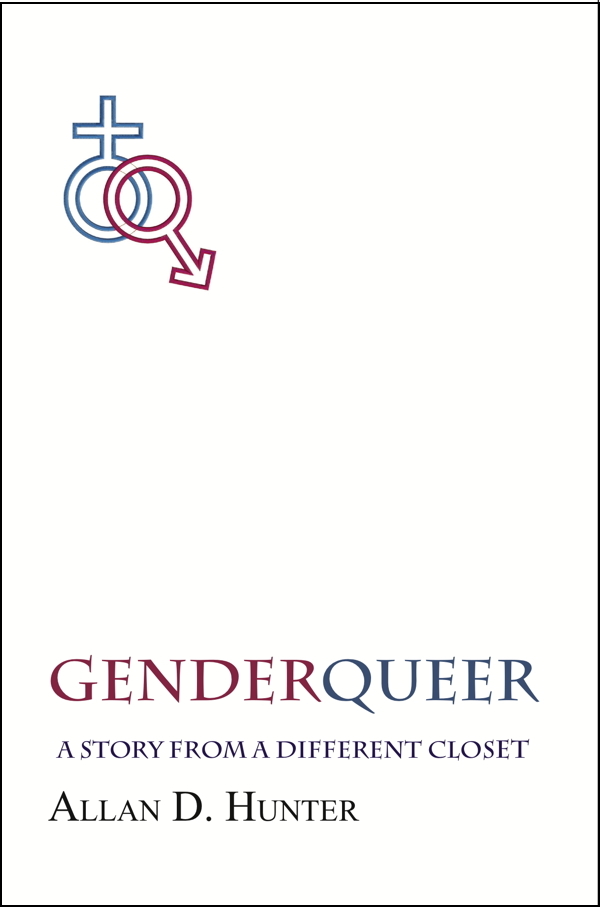
Front Cover


That's the front cover, of course.

Here's the back cover and spine:

Back Cover & Spine
ahunter3: (Default)
I received from Sunstone Press the text of my manuscript, "formatted" and cleaned of violations of the Chicago Manual of Style and corrected for typos and whatnot, for a final author's opportunity to change anything before it moves forward to typesetting.

I have now gone past a landmark that I never reached with either Ellora's Cave or NineStar Press: I'm looking at the content of my book as it will be when it is released, give or take any changes that I make at this point.

If you are not an author--or even if you are but haven't as of yet worked with a publisher--the impact of that may not be apparent. Publishers accept an author's book contingent on a successful round of edits. Changes. Essentially, they're saying they would like to publish your book but first they want to do some things to it.

Even an established author with a high profile is not immune to changes to their work, and I'm not merely talking about catching typos and fixing errant punctuation, either. I've heard that when John Steinbeck submitted Travels With Charlie, the editor modified quite a bit of it before it went to press.

So although an acceptance letter brings great joy, it soon leads to apprehension and trepidation: "Yay, finally my book will be published. I wonder what they'll want me to cut or write differently or stick in? Will I hate it?"

In my case, it wasn't a hypothetical situation, either. My editor at NineStar, in 2017, wanted to kill the first 35,000 words, the first five years of the story, and start it in the middle. "You can put some of it in as flashbacks, maybe", he told me. This was so far from acceptable to me that I ended up asking to have my contract revoked and my rights reverted back to me. Having a contract to publish and then finding the editing process so destructive that I had to pull out felt like being rescued from a sinking ship only to find out that my rescuers were cannibals and that I was better off jumping back into the ocean.

So although I had heard only nice and supportive things said about my manuscript by Sunstone so far, I could not relax or rejoice just yet. The editing pen still loomed over my work like the Sword of freaking Damocles and I'd wake up in the middle of the night imagining all kinds of awful dilemmas, horrible choices I might have to confront, depending on what they asked of me.

But they like it! They really like it! (He says, sounding oddly like Sally Fields). I've finished reviewing the first two thirds of the book and the book is still my book, intact, not missing any limbs or vital organs, its face not rearranged by plastic surgery into something foreign. The editor at Sunstone has a light touch and I'm seldom aware of where anything was changed, and where I do see it, he's usually made it cleaner and clearer.

I'm starting to feel like Sisyphus would upon getting the damn stone up over the rim of the slope and up onto a flat level place. Oh, sure, something could still go wrong. A meteor strike could vaporize the offices of Sunstone Press, or the economy could go into such a tailspin that the entire publishing industry shuts down. But I'm starting to feel optimistic that this is actually going to happen this time.


———————

This LiveJournal blog is echoed on DreamWidth, WordPress, and Blogger. Please friend/link me from any of those environments on which you have an account.

————————

Index of all Blog Posts
ahunter3: (Default)
I'm happy to report that I have a contract with Sunstone Books for the publication of GENDERQUEER: A Story from a Different Closet. Sunstone is a Santa Fe NM based publisher, which I'm happy about since the action in the book takes place in New Mexico. I don't have a formal release date yet but I expect it to come out in the general vicinity of January 2020.

GENDERQUEER is the coming-out and coming-of-age story of a gender nonconforming male. Set in the late 1970s, it's a work of nonfiction and highlights the realness of an identity that is not gay, bisexual, lesbian, or transgender, but isn't cisgender and heterosexual either -- "it's something else".

It's a work of nonfiction. It's my story.

GENDERQUEER is a 96,000 word tale with real people, characters and dialogue, that is intended to make some fairly complex social concepts accessible to people who aren't regular readers of political and social theory.

It will be my first published commercial piece. So I'm a debut author.


I don't feel like a debut author. I feel like an old and rather weary traveler plodding across the damn desert.

That probably has something to do with the fact that this is the third time I've had a contract to get this book published.

Ellora's Cave was going to publish it in 2016 but they went out of business.

Original Announcement
Retraction

Then, in 2017, StarNine Press said they would publish it, if I worked with the editor to shorten and tighten the first third of the book. It turned out that by "tighten" they meant "discard", and we were unable to reach a mutually satisfactory understanding and publication was eventually cancelled at my request.

Original Announcement
Retraction


I sent out nearly 1500 queries to literary agents about this book and never succeeded in getting a lit agent. Eventually I began querying small independent publishers and at this point the tally of those is 117 queries to publishers, resulting in three signed contracts.

The third of which had jolly well better be the proverbial charm.

———————

This LiveJournal blog is echoed on DreamWidth, WordPress, and Blogger. Please friend/link me from any of those environments on which you have an account.

————————

Index of all Blog Posts

Depression

Jun. 1st, 2019 08:22 am
ahunter3: (Default)
I'm in a dismal mood.

Doesn't happen very often. I'm seldom depressed. When I first obtained a clear sense of my variant identity, I received along with it a political explanation for why I felt pushed aside, why I was so often reviled and hated when I hadn't done anything to hurt anybody, why I didn't make friends, was perennially unpopular, and so on. It was also a political analysis that explained a lot of the worrisome aspects of the larger world to me, things like tyranny and oppression, poverty and inequality, even morality and spiritual meaning in life. So it was very empowering, and gave me optimism, courage, even some modicum of patience.

And you can sort of see why having that kind of understanding in my head made me want to share it, figuring it would offer those things to a lot of other people as well. And why wanting to share it gave me a mission and a purpose in life.

But I do get discouraged and trammeled down sometimes and it's been like that these last couple weeks.


I had a publisher on the line. I had a contract in my hands. There were problems and concerns -- I never quite felt that the editor I was interacting with had a clear understanding of the gender identity thing, either mine or MOGII* identities in general, beyond the average person's mainstream popularized shorthand stuff, and he didn't seem curious or sufficiently intellectually engaged to see what it was that I was trying to say to the world. It was more like "Hey, you write well, this could be an interesting entertaining book with a bit of effort".

I thought maybe I could work with that but the lack of any sense of being on the same channel worried me. He also gave every sign of wanting to be heavy-handed about changes. "I think you should add a scene where you muse about this, and then a scene where you blast out of town and flip off the city limits sign as you drive into the sunset... and I'd get rid of these scenes in this next section..." I got mixed messages about how much of these editorial suggestions I could veto and still have them publish the book. On the one hand, he stipulated that the publisher would not make any changes that the author did not approve, and when I did a preliminary round of edits , adding some scenes he suggested but not deleting material that I wanted to keep, he replied (somewhat sourly, I thought), "Well, do it your way, it's your book, and we don't want you to look back after publication and wish you'd never heard of us". Alongside of these ambivalent-sounding reassurances about my authorial authority, I received periodic comments about how the publisher could not afford to put a book out there that had so many flaws and weaknesses that it simply would not sell, or that would be an embarrassment to the publishing company.

I was sent a document to review and sign, titled "draft contract", and I wanted to modify some clauses to safeguard that the book would come out my way (final word on the book's cover, title, back-cover blurbs, publicity descriptions or synopsis, etc) and also push for a better deal in some places (better % royalties beyond the 2500th copy, because I'd be financing most of the publicity efforts, as tends to be the case with small publishers) -- I figured it did say draft proposal, after all, and that they might say "nope, you can't have that" and if so we'd negotiate to a compromise and then I'd sign and they'd sign and I'd hold my breath and hope we could work together on the edits, right?

Uh uh. I got a reply email stating that the publisher had decided they had too many projects going on and had decided not to publish my book after all, best of luck with it elsewhere, etc. After a day to cool off I wrote a letter of inquiry (and of hubris-acknowledgment). He confirmed that yeah, it was because I'd given them pushback instead of just signing the contract as is. And nope, no room at this point for continuing the discussion, sorry. So that was that.


What are your symptoms when you get down and despondent and mopey?

For me, it's like this:


* I get mad at myself and start blaming myself for the outcome, even though I'm still capable of an intellectual analysis that tells me I didn't do self-destructive things here. I blew it. I had a contract in my hands and managed to drive away the publisher. I must not really want to get my book published, I sabotage myself. Heck, I probably sabotage myself right and left every day, finding ways to not network or communicate, so that I can be a fucking dilettante and keep pretending to be an "activist" or a gender "revolutionary" when I'm really just Walter Mitty and none of this is real.

* I question my beliefs and understandings. Intellectually, I could tell you that it is good for anyone to question what they purport to believe; it makes the beliefs that withstand such questions more valid and sound, and it makes the person who subscribes to them less defensive and more genuinely confident and all that -- but in this mood, the belief-questioning is very dark and takes this form: "My difference probably isn't that I'm differently gendered. That's just an excuse. I'm inferior, there's something fundamentally wrong with me. People mocked and harassed me as a kid because I was pathetic, not because I was a sissy. I have had problems making friends and getting accepted socially because I'm not fun, not friendly, don't remember what is important to other people, and in particular because I don't properly soak up how to be, the little memes and clues, so I am not a part of things. I'm probably impaired neurologically or psychologically. Maybe I'm autistic, or I have some personality deficit so that I'm capable of doing mechanical things like dress myself or do data entry or write term papers for college classes but my brain isn't wired correctly to do people-interaction. Yeah, there's something wrong with me.

* The dark stuff isn't all of the self-blame variety. I have other forms of gloom to wallow in. Why have I gotten so little traction out of forty years of trying to share and explain these ideas? Well it's because I belong to a sexually dimorphic species, and I'm a sissy male, a feminine male, hence a minority and marginalized because of that; and I can try to call that "political" and make an "issue" of it all I want, but my species isn't buying it, there are evolutionary forces that select against it becoming okay for males like me to be accepted and embraced by society. Or (brain switches channels to a different gloomy perspective) it's a conspiracy of sorts, my set of theories and explanations is a potential meme that conflicts in parts with the predominant rising body of thought, which at the moment is the mainstream transgender narrative, What I am saying or trying to say is rejected because the popular social dialog only has room for a few prevailing ideas to proliferate. My notions are no doubt seen as transphobic, or at least they’re seen as incorrect and inaccurate when people compare them with the established transgender explanations. And back in the earlier years, before transgender viewpoints were established, my ideas were probably worrisome to gay people and their supporters, and were perceived as homophobic. So, you see, communication between an individual and the rest of their surrounding culture isn't free exchange; ideas that are not the ones chosen by the consensus get pinched off and blocked because they introduce too much noise, and mine are noise, not the memes that have been embraced and selected for wider audiences. Or (switching channels to one with even less light in it)…

* Ha, so silly to dwell on how poorly I fit as a male, when I should take note of how poorly I fit as a human being. I am not doing this "being a person" thing very well. I was born to a species whose tasks of life and patterns of behavior and interaction and challenges and so forth are a bad fit for me, and not much fun. I am tired of this. Not in the sense of wanting to be dead, not in the sense of craving non-consciousness and non-existence, but, yeesh, if I die and get to come back, I really hope I can come back on some other planet as some other species with a different nature, different characteristics. Or I could come back as a kitty cat, and live in back alleys and prey on mice and if I'm lucky get adopted and taken indoors. Or I could try my hand at being a sycamore tree, or bread mold or something. But this "being a human being" thing doesn't seem to be shaping up to anything like a passing grade. I'm just no damn good at it.


Meh. My way of coping with depression is to ride it out, and to wallow in it self-indulgently and immersively, until I get annoyed and angry and break out of it. I don't think I'm very pleasant company for the duration of these moods (I get even more self-immersed than I usually am, which is admittedly a rather narcissistic threshold to start with); I only listen to the loved ones and important associates and colleagues in my life in a sporadic and distracted way, and I get very forgetful (more spacy than usual, and again I have an embarrassingly bad baseline to start with). And I'm awake much of the time I should be sleeping and dozing off when I should be alert and awake.

But it's not like I don't understand why I would be feeling depressed. I got sufficient reason. So it's normal and natural and part of life for me.

I'll bounce back.


* MOGII = "minority orientations, gender identities, and intersex" -- an alternative to the ever-expanding LGBTQIAA++ acronym


———————

This LiveJournal blog is echoed on DreamWidth, WordPress, and Blogger. Please friend/link me from any of those environments on which you have an account.

————————

Index of all Blog Posts
ahunter3: (Default)
The Art of the Coming Out Story: Seeking the Sweet Point

positioning, literary agent, publisher, show don't tell, writing


A pair of somewhat-recent rejection slips:

It is written in what I will refer to as an "extreme" narrative, i.e. it reads like a diary. The promise of an interesting read on the subject of a young man's struggle to determine his sexuality is never realized because the author lapses into a commentary on his being bullied by those who prey on the "undecided" identity seekers. One thing that makes this interesting is that although the author identifies more as a female, his orientation is clearly heterosexual. Readers may well be inclined to 'slug' through the pity in order to see how his obvious conflicts are resolved. Three stars because it is at best a 'possible."


-- from Black Rose, a small independent publisher

You’ve struck on relevancy with your premise. The story of coming-of-age trans during the 1970’s while battling a prejudice environment is compelling, but there still needs to be a gripping arc to carry the narrative. The characters didn’t come to life for me. I felt more like I was being told events, rather than living them with Derek.


-- from Judith Weber of Sobol Weber, a literary agency


I'm not sure how I can do a better job of making the characters "come to life" and bringing the reader to the point of living events with my main character Derek while at the same time avoiding making it an even more "extreme narrative" that reads "like a diary" in which readers have to "slug through the pity".

Meanwhile, I'm continuing to participate in author's reading events at Amateur Writers of Long Island as described in this earlier blog post. I read a 1500-word excerpt from the 8th-grade chapter early in the book and the other authors gave me much more pleasant feedback than the publishers and lit agents:

Your ability to express your vulnerability is amazing! It flows with ease.

Well-written, strong emotions. Sad, powerful.

Very well written and effective. Keep at it, it's near perfect.


Still, among the rejection letters I've received over the years, there have been two main themes (aside from form letters and short choppy "not for me" replies): that I don't have enough of a platform and that the story doesn't sufficiently grab the reader and draw them in.


We were impressed by The Story of Q's holistic approach to the underwritten topic of growing up queer. However, we struggled to engage emotionally with Derek because of the lack of specificity in prose. For example, it was difficult to understand why, in middle school, Derek found boys' behavior to be "bad" (rather than merely displeasing or disruptive), when Derek had not expressed a desire to be "good" or why Derek was ostracized growing up without knowing how exactly he was teased in each school he attended.
-- Nora Long for / Susan Cohen at Writer's house

I read you query with interest. Your premise is unique and definitely stands out! Unfortunately, the writing style did not draw me into your story's world as much as I would have liked.
-- Johanna Hickle at Talcott Notch


Well, that kind of feedback tends to make me think of perhaps letting go of my self-imposed barriers on manuscript length. Because for any individual event, writing it as a vivid scene with dialog and main-character mental processes and feelings and sound and smells and colors and all that means taking up more words to do it. In a vintage-2014 blog post I explained why. I'm still sure that the story I'm telling is the story I want to tell (as opposed to trying to include less). So the price tag for punching it up further is, at a minimum, to stop worrying about manuscript length and just let it take as many pages (and words) as it takes, you know?

Many of the books I've enjoyed the most have been quite a bit longer than The Story of Q in its present incarnation: Marilyn French's The Women's Room at 135,700 words (526 pages), Marge Piercy's Small Changes at 171,400 words (562 pages), Wally Lamb's She's Come Undone which comes in at 116700 words (465 pages). Mine has hovered around 97,000 words which would probably take up somewhere between 320 and 375 pages. Hmm, I could include a lot more dialog in the scene where the girl from Boston comes to visit and she become the love interest I obsess about... and I could insert some scenes with Boy Scouts illustrating more about how I was sort of not fully merging and kind of holding myself back from them, maybe a scene where the other boys are telling dirty jokes or something, and maybe some scenes at pot parties where I get into philosophical conversations with some of the girls while we're stoned...

But I also looked at some of the classic coming-out stories, to compare for length within the same genre, and that's a bit scary.

Rita Mae Brown's Rubyfruit Jungle ("Bawdy and moving, the ultimate word-of-mouth bestseller, Rubyfruit Jungle is about growing up a lesbian in America--and living happily ever after") is only 246 pages (63,960 words).

The Best Little Boy in the World by Andrew Tobias ("The classic account of growing up gay in America. An autobiography in which he spoke of his experiences as a gay boy and young man. He published it under the pen name "John Reid" to avoid the repercussions of being openly gay") was 247 pages (64,220 words).

Jan Morris wrote Conundrum ("One of the earliest books to discuss transsexuality with honesty and without prurience, tells the story of James Morris’s hidden life and how he decided to bring it into the open, as he resolved first on a hormone treatment and, second, on risky experimental surgery that would turn him into the woman that he truly was.") in a mere 176 pages (45,760 words).

Mario Martino did Emergence ("The autobiography of a female-to-male transsexual, written as a cooperative effort by the author with a medical journalist. It is one individual's story of the transition from female to male") in 273 pages (70,890 words).

The Last Time I Wore a Dress ("At fifteen years old, Daphne Scholinski was committed to a mental institution and awarded the dubious diagnosis of "Gender Identity Disorder." She spent three years--and over a million dollars of insurance--"treating" the problem...with makeup lessons and instructions in how to walk like a girl.") was 224 pages (55,552 words).

Stone Butch Blues by Leslie Feinberg ("Woman or man? This internationally acclaimed novel looks at the world through the eyes of Jess Goldberg, a masculine girl growing up in the "Ozzie and Harriet" McCarthy era and coming out as a young butch lesbian in the pre-Stonewall gay drag bars of a blue-collar town") was 308 pages (77,000 words).

And Jennifer Finney Boylan's She's Not There ("The exuberant memoir of a man named James who became a woman named Jenny. She’s Not There is the story of a person changing genders, the story of a person bearing and finally revealing a complex secret; above all, it is a love story") ran to 352 pages (91,520 words).

None of those is quite as long as The Story of Q. Is that worrisome? Relevant? I don't know for sure, but it doesn't make me very comfortable with the notion of making my book yet longer in pursuit of more vivid scenes and paragraphs.

I had two publishers sign contracts to publish this book; I need to remember that and not blame my writing for the rejection slips I get.

I'm looking for the sweet point, where I've laid down the trajectory of experiences I went through that culminated in me deciding I had a different kind of identity than the people around me, and explained that in enough detail and enough emotional vividness to convey that.


————————

This LiveJournal blog is echoed on DreamWidth, WordPress, and Blogger. Please friend/link me from any of those environments on which you have an account.

————————

Index of all Blog Posts
ahunter3: (Default)
I wrote a book about being genderqueer and I'm trying to get it published.

Those of you who've been reading my blog for awhile now are well aware of that, but I have recently joined several Facebook groups where I may not have mentioned that, and I'm now echoing my blog in more places in hopes of reaching a wider audience... and it's been awhile since I blogged about the book itself. Most of my recent posts have been about some aspect of gender or genderqueer experience.

Anyway, yeah, it's a memoir (nonfiction, my own story), a coming-of-age and coming-out story, about 97,000 words long (probably about 325 pages, give or take). And I've been querying literary agents since 2013 and small publishers (the sort that you can query directly) since 2015.

Here's where things are at at the moment:


THE REQUEST FOR A FULL


Every rare once in a while my queries to literary agents have resulted in a request to see and evaluate the full manuscript, an event known in the world of authors and author-aspirants as a "request for a full". It's akin to when sending in your resume results in an actual job interview. I've had six of those so far.

The most recent was from Lucinda Karter (or, more precisely, from her assistant Jadie Stillwell) of Jennifer Lyons Lit Agency, on November 17 of last year. I sent in the full manuscript and didn't hear a peep, so on December 8 I sent a follow-up inquiry, just asking for confirmation that they actually received it. They had; Stillwell apologized for being behind and said they hadn't had a chance to look at it but would get to it in due course.

At some point in the spring, I went back to querying lit agents, if only to distract myself from the waiting.

Eventually, the 8th of March rolled around, and it had now been three months since I'd heard anything from them and four months since I'd queried them, so I sent a follow-up email, inquiring if I had perhaps missed a critical piece of correspondence. On March 20th, still not hearing anything, I repeated that inquiry, and on March 30th I got a somewhat formletterish "thanks for the opportunity to read but unable to fully connect with the characters and will have to pass" rejection letter.


THE DOLDRUMS


One of the literary agents that I subsequently queried wrote back to say my proposal looks interesting but that they have a policy of only considering material submitted to them exclusively — so did anyone else have it? Of course they did. So in a back-and-forth exchange of emails we established that they'd be happy if I waited until any still-outstanding queries were rejected or else timed out with at least six weeks elapsing from the time I queried them, and then subsequently didn't send any other queries out until they'd had a chance to make their evaluation. That point will be on April the 12th, two days from now. I'll let them know on the 12th that they now have exlusivity and then an additional six weeks will tick by before their exclusivity-window expires.

It's a long shot but all inquiries to lit agents are long shots. I decided to go for it. But it's meant not doing anything as far as lit agents are concerned from week to week and (at this point) month to month.

It's hard to feel fired-up and like you're doing something towards getting a book published when you're just sitting around waiting for a calendar date to crawl by.

Meanwhile, with the publishers, I'm in the same damn situation: there was a publisher I wanted to query, one that was highly recommended on the queer / nonbinary / minority orientation and sexual orientation and intersex FaceBook groups as a good solid publisher for LGBTQIA titles. They, too, have a policy of exclusivity. So I had to wait until the previous publisher submission (to Kensington Books) expired from lack of activity and then sent them my query, which they've now had since January 23. They want 90 days to evaluate manuscripts, so they've got exclusivity until April 23, another thirteen days from now.

So I've been sitting on my thumb, metaphorically speaking, not sending anything to anyone and watching the damn calendar.


BROAD OVERVIEW / REVIEW OF THE SITUATION


I have twice had a publisher sign a contract with me to publish this book. Generally what happens when a publisher signs a contract with an author is that the book goes into print. In the first instance, the publisher, Ellora's Cave, went out of business and revoked all pending books. In the second instance, with NineStar Press, the editor wanted to cut the first third of the book entirely, and we were unable to establish a working relationship. (I experienced the editor as heavy-handed and insulting, and I gather that he found me arrogant and impossible to work with). So I asked them revert my rights back to me.

This is extremely frustrating, as you can probably imagine. The relief and excitement and joy of having a publisher pick up your book, the anticipation of seeing it listed on Amazon and perhaps on a book stand in a book store, the enthusiastic planning of promotional talks and book-signings and lecture tours and all that... ripped out from beneath me.

I was going to write that this isnt fun any more. That's misleading: it was never any fun, this process of trying to sell agents and publishers on the idea of publishing my book. I detest this entire process, just as I hate doing job searches. I have said in the past that trying to sell myself like this ranks right up there with cleaning all the toilets in Grand Central Station with my tongue. So "isn't fun any more" isn't the applicable phrase here. What's changed, I think, is that I won't be able to feel any of that relief, excitement, anticipation or joy when I finally do once again have a publishing contract. At this point I don't think it will seem real until the damn thing's actually in print and I am holding a copy in my hands. Maybe not even then.

"Well", you may be thinking, "why don't you just self-publish?"

It's an easy enough process to create a print run of my book. I even have a routine that allows me to print the whole book onto 5.5 x 8.5 format, two pages to a standard 8.5 x 11 sheet of paper, double-sided, so it can be whacked neatly in two with an industrial sheet cutter and bound. I could get bids and go with the cheapest bid, and that's before I even look into companies specifically geared to help authors self-publish.

Electronic printing is even more effortless, and free. I can generate a PDF at will, and Amazon (among others) will readily help me convert it to other standard eBook formats for paid download.

None of that is at all difficult. Most of that is not relevant.

The difficult, and relevant, part of what makes publishing different than mere printing is distribution and publicity. Running off five thousand copies of my book (and/or generating an eBook for electronic distribution) doesn't get it into people's hands. It doesn't get it reviewed. There are human activites that successfully overcome those barriers, promotional activities. I'm not good at them. If I were good at them, this would be a very popular blog with hundreds or thousands of weekly readers. It isn't. I'm not.

I'll still have to gear up to plan and execute a promotional campaign even with a traditional-model publisher, unless I get a large publisher on-board (unlikely); but even a small publisher makes the book "authentic" to the world of reviewers and opens up opportunities for distribution and consideration. I'm particularly interested in seeing it picked up as reading material for gender studies, LGBTQ studies, feminist theory, and other related academic course work, and hopefully also to find shelf space in LGBT community centers and support group meeting spaces and whatnot.


READINGS


One thing I have been doing more of lately is attending authors' groups where people bring samples of their work-in-progress and read from them and get feedback from the others there. I've been attending the Long Island Writers' Guild and the Amateur Writers of Long Island in recent weeks. Of the two, I like the format used by the latter somewhat better, as they allow up to 1800 word samples to be read and spend more time discussing each selection before moving on to the next. I've enjoyed them both, though.

The feedback I've received is encouraging. The people say my writing in general is vivid and effective, the characters and their behaviors and dialog strongly drawn, the paragraphs and phrases well-constructed. That's not to say I haven't received useful criticism, of the sort "you could do more of this up here before he says that" and "I found it a bit confusing when it jumped to this next scene, is that supposed to be later the same week or what?" and so on. But the overall takeaway is very good: my writing does what I want it to do, it works. At least in 1800-word chunks. (I still yearn for more feedback on the entire book as a satisfying or less-than-satisfying whole).


STATS


total queries to Lit Agents (counting requeries): 1171
Rejections: 1092
Outstanding: 79


As Nonfiction, total: 944
Rejections: 866
Outstanding: 78


As Fiction, total: 227
Rejections: 226
Outstanding: 1


total queries to Publishers: 30
Rejections: 22
Outstanding: 1
No Reply 3+ Months: 6
Pub Contract Signed, went out of business: 1
Pub Contract Signed, rights reverted: 1


————————

This LiveJournal blog is echoed on DreamWidth, WordPress, and Blogger. Please friend/link me from any of those environments on which you have an account.

————————

Index of all Blog Posts
ahunter3: (Default)
I've been on a 3-month hiatus from sending out query letters. On the publishers' front, I had an unanswered query ticking away waiting for the "allow 3 months for us to reply" window to expire, because the next publisher I wanted to query asks for exclusivity. Just sent them a query this morning. And now the clock resets again.

Meanwhile, queries to literary agents has also been suspended for awhile because I got a request for a full (in other words, a lit agent responded to my query letter with a request for me to send in the entire manuscript for their consideration) and I've been waiting on the verdict to that before querying other lit agents.

I'm mostly in a mode of not taking the lit-agent-querying very seriously. I mean, I've sent out over 1000 queries to lit agents and never gotten an offer to represent me. In contrast, I've only sent out 39 queries to publishers and that resulted in two publishing contracts. (One publisher, Ellora's Cave, went out of business, and the other, NineStar Press, assigned me an editor who wanted deep cuts to my book that I wasn't willing to make). Be that as it may, however, only 6 of those 1000+ queries to literary agents resulted in a request for a full, and this is one of those 6.

Wendy Sherman of Wendy Sherman Associates took one day in 2013 to examine my manuscript and decide not to pursue. I had been introduced to her at a paid pitch conference and I don't know if she would have requested to see the manuscript if that had not been the case.

Elizabeth Trupin-Pulli of Jet Literary had my manuscript from late April until early July in 2015 before deciding against representing my book.

Linda Loewenthal of David Black Lit Agency took only six days in August 2015 before declining with a very thoughtful analytical personally tailored rejection letter explaining what they did and did not like about the book.

Anjali Singh of Ayesha Pande Literary held onto it for a month in 2016 before also writing back with praise as well as analysis for what gave her misgivings about the book and deciding not to go forward with it.

Eric Ruben of The Ruben Agency had my manuscript in hand for a month last spring and then sent me back a cursory "not for me" email.


Hmm, it's helpful for me to have compiled that. I see that this current request-for-full has not been awaiting a reply for such an unusually long time after all. (Two months as of January 17th).


————————

I am now echoed on DreamWidth, like many other LJ folks. My DW acct is here. Please friend/link me on DW if you are a DreamWidth user.

————————

Index of all Blog Posts
ahunter3: (Default)
I resumed querying after breaking up with my publisher last month. I tend to consider the practical side of that as being the querying of small publishers, but I also resumed the querying of literary agents.

The reason I think of the queries to publishers as being the practical querying is that I've sent out over 1000 query letters to lit agents, of whom exactly six have asked to see the full manuscript, none of whom then went on to offer me a contract; whereas I have sent 32 queries so far to small publishers who permit directly querying by authors, of whom three expressed interest, two of whom subsequently offered me a contract.

Be that as it may, I received a response earlier this week from one of the lit agents I'd queried, asking for a copy of the full manuscript for her to read.

As always, it guarantees nothing; the other five times this happened, the final outcome was a rejection.

And, as always, the additional awareness of someone else's eyeballs on my book soon prompted me to see things that needed changing! "Hmm, that paragraph has a couple sentences about having outgrown my previous naive ignorance, but I no longer have the section from early childhood where I discuss not knowing such things... that should be removed. Oh, and in this incident here, I go into a lot of details about what I explained to my date, that makes it read as if I tended to dwell on that a lot, like that conversation was a representative sample of many such conversations, let's lighten that up a bit..."

Anyway, stay tuned. I'll cross the requisite finger and maybe something will come of it this time, you never know.


————————

I am now echoed on DreamWidth, like many other LJ folks. My DW acct is here. Please friend/link me on DW if you are a DreamWidth user.

————————

Index of all Blog Posts
ahunter3: (Default)
It's been almost exactly a year since I made the announcement that Ellora's Cave would not be publishing my book after all due to the fact that they were going out of business and cancelling all contracts.

This time around, the situation is different, although the result is approximately the same. NineStar Press, the publisher I signed with in May, stipulated from the outset that their acceptance of my book for publication was contingent on me working with them to reduce the size of Part One (which is the first third of the book).

I fully intended to honor that agreement, but once we got past the generalities and shifted to the actual editing process, I wasn't willing to make some of the cuts that the editor thought were necessary.

Yes, I've been haunted by the stereotype of the self-important newbie author who thinks every paragraph that went into the original manuscript is a golden masterpiece, that every utterance is sacred. I've tried to avoid being the kind of author that publishers and editors tell war stories about at conferences, and I hope I'm not parting company from NineStar leaving too much of a bad taste in their mouths, but, yes, I'm admittedly picky about this manuscript. I'm not seeking to get a book published. I'm seeking to get this book published.

Since we weren't able to reach a mutually satisfactory agreement about the cuts, and could not reconcile the impasse, I requested to have my rights reverted back to me. The folks at NineStar were very prompt and cooperative once I made the request, which has enabled me to resume querying immediately.

Oh well... other authors have talked about wallpapering their room with rejection letters. I guess I'll get to be one of the few who gets to wallpaper a room with acceptance letters and contracts that still didn't quite result in a published book.

On the one hand, I've had rather rotten luck so far -- the first publisher going out of business and irreconcilable creative diffs with the second -- but it also means two different publishers bit. I'll find a third.

————————

I am now echoed on DreamWidth, like many other LJ folks. My DW acct is here. Please friend/link me on DW if you are a DreamWidth user.

————————

Index of all Blog Posts
ahunter3: (Default)
I feel a little bit like an air traveler whose plane has reached the destination city area and now the plane is circling round and round in a holding pattern, waiting for their turn to use the runway. I had a little bit of a suggestion from the editor about the types of changes that would be requested, so back in July I did some preliminary edits, but I've pretty much taken that as far as I can until the editor actually gets to my book.

The one thing that's available for me to focus on (and obsess about, to be honest) is the publicity effort. I don't want to look back on this a few years from now and think "I could have reached a far wider audience if I'd contacted these people or advertised it and promoted it over there". Well, I probably will anyway, but I'm at least inclined to put a fair amount of effort into trying to think of such things NOW, when I can act on them, and do what I can (or what I can afford to do).

• I have a database I've been compiling all year, with over 10,000 institutions and 1-8 contacts for each institution. These are organizations or resources who might be interested in selling, stocking or reviewing my book when the time comes. Some of them are academic: women's studies or gender studies programs, and campus-based LGBTQIA centers. Some are public or scholastic libraries. Some are independent bookstores. Some are independent community-based LGBTQIA centers. A few are reviewers, including the new phenomenon, "booktubers", people who post YouTube videos in which they review interesting books.

• My publicist -- same guy who got me bookings to address women's studies classes and LGBT groups last spring -- will continue to get me speaking engagements and is going to focus on getting me hooked up with established reviewers. Our first focus will be reviewers who review books that have not been released yet. (But until the editor and I reach a finalized manuscript, there's no advance reader copy, i.e., ARC, available, so even this is stuck in a holding pattern at the moment). He is also working with me to craft emails to the receipients in my database.

• We're discussing where to place ads. Is a more expensive higher-profile ad likely to attract the attention of a reviewer? Would a barrage of lower-priced electronic ads that accompany people's Facebook or Twitter viewing experiences give me more bang for the buck? The ads themselves have to be designed. I don't feel like I have the gift for formulating ad copy, for recognizing the ideal catchy descriptive phrases that will make someone think "Hey, that sounds like something I should read" or "Hmm, that's different and provocative, I wonder what that's about?" Here, too, we're still waiting on a chosen book cover and the prospects for quotable reviewer's statement excerpts. To an extent, ads can be designed with an "insert cover art here" placeholder.

Eventually, there comes a time for saying "I did what I could and it's out of my hands now".


————————

I am now echoed on DreamWidth, like many other LJ folks. My DW acct is here. Please friend/link me on DW if you are a DreamWidth user.

————————

Index of all Blog Posts

January 2026

S M T W T F S
    1 23
45678910
11121314151617
18192021222324
25262728293031

Most Popular Tags

Syndicate

RSS Atom

Style Credit

Page generated Jan. 6th, 2026 09:09 pm
Powered by Dreamwidth Studios